
The answer first, because this one is decided at a counter, not in a meeting. Since 15 September 2026, Oman requires every imported sea and air consignment that needs mechanical handling to arrive on pallets. Land border crossings have been covered since 15 July 2026. Wood, plastic and metal are the approved materials. “Wood” in that sentence means solid wood carrying a legible IPPC mark. Molded presswood pallets are legally exempt from ISPM 15, and they bear no mark at all, because there is nothing on them to mark. That gap between legal status and visible evidence is the most expensive detail in a Gulf shipment right now.
What Oman Actually Published
The instrument comes from the Royal Oman Police, Directorate General of Customs, issued under Article 44 of the GCC Unified Customs Law. It is short and it is not optional.
Two dates matter. Land arrivals were covered from 15 July 2026. Sea and air arrivals from 15 September 2026. The trigger is the arrival date at a Muscat, Sohar or Salalah gate, not the date the container left your factory. Cargo dispatched in August and landing in October is caught.
Non-compliant consignments can be refused and returned to the country of origin. That is the phrase in the notice, and it is the phrase to plan around.
The carve-out covers cargo that cannot be handled mechanically: grain, aggregates, liquids in tank containers, pipe, coils, marble blocks. None of it is automatic. If you ship loose bulk, ask your Omani broker in writing.
The Stamp Problem
ISPM 15 governs wood packaging made from raw wood. Processed wood sits outside the standard entirely. The UK plant health portal spells out the exemption in the wording every national plant protection organisation uses. It covers “wood packaging made wholly of processed wood material, such as plywood, particle board, oriented strand board or veneer that has been created using glue, heat or pressure, or a combination thereof.”
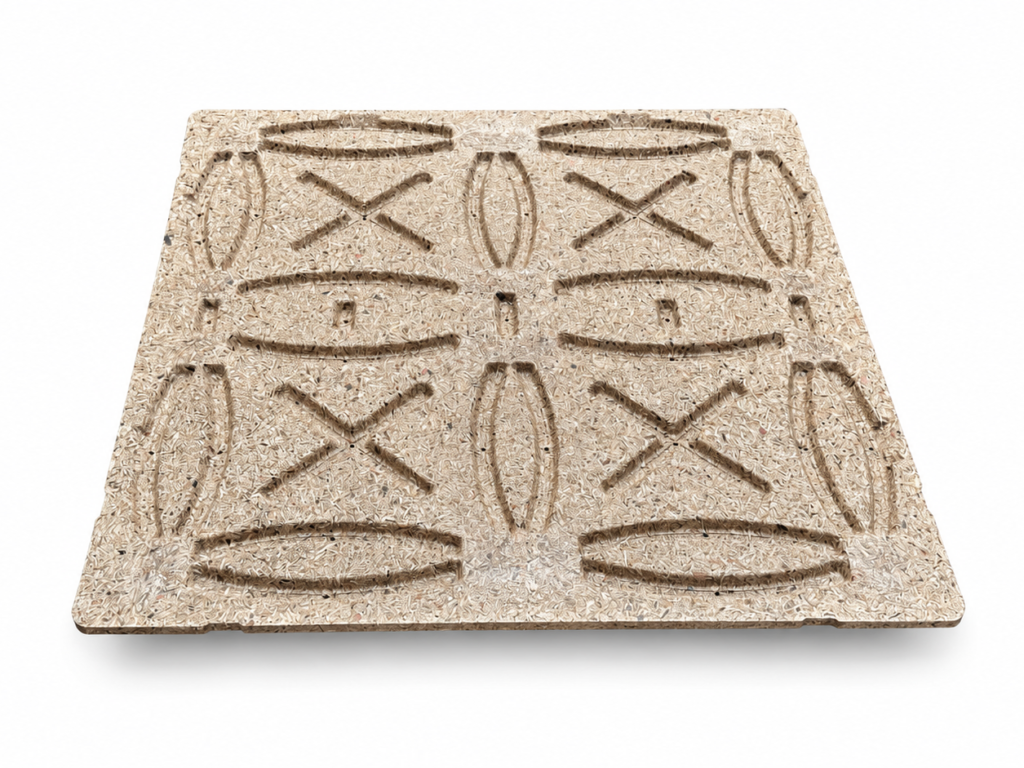
A molded pallet is that material. Ground fiber, binder, heat, clamp force, one piece out of the tool. No board, no nail, no bark, no pest habitat.
Now picture the pallet itself. It is grey, heavy, wood-grained and shaped like every other pallet in the queue. It looks exactly like the thing that is supposed to carry a stamp. A customs inspector at Sohar has perhaps ninety seconds per unit and a checklist that starts with the mark. Nobody at that gate is going to run a materials analysis.
This is not a complaint about Omani enforcement. It is a description of how every phytosanitary gate on earth works. Inspection is visual because inspection has to be fast.
A Regulator Already Documented This Failure Mode
Australia’s agriculture department published the mechanism years ago, in a note about veneer peeler cores.
Veneer peeler cores are not regulated under ISPM 15. Build them into a pallet, though, and “the wood is no longer readily identified as veneer peeler core.” The consignment “may be viewed as being untreated,” which leads to treatment on arrival or rejection of the whole shipment.
Read that twice. The regulator is saying that legal exemption does not survive assembly. The finished object no longer announces what it is made of. A molded pallet has the same problem in a harder form. It is one pressed component that looks like timber.
One more technical wrinkle. ISPM 15 Annex 2 treats a composite unit as one unit for marking purposes. If your design mixes a solid wood block or a timber runner into a molded deck, you have pulled the whole pallet back into scope. Keep the wood out, or expect to treat and mark.
Five Documents That Do the Work of a Stamp
The exemption is real. It just needs to travel as paper, because it cannot travel as paint.
A processed-wood declaration. One page, on letterhead, quoting the scope exemption and naming the material class. Not a marketing brochure. A sentence that an inspector can read and initial.
A bill of materials. Fiber species and origin, binder type, add ratio. UF and MF systems run at 10–15% add-on. MDI runs at 4–5%. If your binder is MDI, say so, because it also answers the formaldehyde question that follows.
Process parameters. Platen temperature, clamp force, dwell time. A 1,600-ton press running a 1.44 m² mold at 150–200 °C for 180–240 seconds does the same job heat treatment does. It does it better, because it reaches every cell of the board rather than a 56 °C core for 30 minutes. Put the numbers on the sheet. They are the substance behind the word “processed”.
A mold identifier and a batch code. Chain the pallet in the container back to a press run, a shift and a tool. This converts an argument into a lookup.
An Arabic–English cover sheet. Oman’s counter officers read Arabic. A bilingual summary costs one translation and removes the single most common reason a document pack gets waved away.
Ship that pack with the commercial invoice, not after the first query. By the time a container is held, the fix costs demurrage.
Put the Claim in the Mold
Here is the part almost nobody does, and it is cheap.
Machine the words into the tool. “ISPM 15 EXEMPT — PROCESSED WOOD”, plus the mold ID, plus the manufacturing country, cast into the underside of every pallet the tool ever makes. An H13 mold runs 250,000 to 300,000 cycles before it needs replacing. The engraving is a one-time line item in the tool drawing. It then repeats on a quarter of a million pallets.
Two rules on this. Never reproduce the IPPC wheat symbol or a treatment code. Forging a phytosanitary mark is a criminal offence in most jurisdictions, and it is the fastest way to lose a market permanently. And keep the wording factual. “Exempt” is a legal statement you can support with the declaration. “Certified” is a claim you cannot.
If you are specifying a new tool this quarter, add the engraving now. Retrofitting a marking insert into a working mold means stripping it out of production for two to three weeks.
What a Refusal Costs
Let us put a number on the downside, because that is what decides whether the paperwork gets done.
A 40-foot container refused at Sohar pays the outbound ocean freight, the return leg, storage at both ends and demurrage while it sits. Fuel is not helping. Brent settled at $116.80 a barrel in September 2026, up 28.5% on August, and bunker adjustment factors follow crude with a lag. A conservative round trip on a rejected 40HQ now runs $3,000–6,000 before demurrage, replacement pallets and the missed delivery window are counted. Our figure, from quotes we see, not a tariff.
Set that against $2–8 per pallet for treatment on the solid-wood alternative. Presswood avoids it on every single trip.
The comparison is not close. Which is exactly why the missing document is so irritating. You are paying a compliance penalty for a product that is compliant.
Where This Rule Bites Hardest
The Gulf is not a small side market, and it is not slowing down.
IndexBox puts the GCC market for wooden flat pallets at $781 million in 2024, up 4.2% on the year. Saudi Arabia takes 68% of regional consumption, roughly 50 million units. [Mobility Foresights values the Saudi pallet market alone at $480 million in 2026](https://mobilityforesights.com/product/saudi-arabia-pallet-market), heading to $780 million by 2032 at 8.4% a year. Saudi container port traffic was 8.03 million TEU in 2024, and every one of those boxes that needs a forklift now needs a pallet underneath it.
Two exporter groups feel the Oman rule first.
Indian shippers, because the India–Oman CEPA gives zero duty on about 98.08% of tariff lines, and India sent $4.06 billion of merchandise to Oman in FY2024-25. Zero duty is a strong reason to ship. It is also a strong reason to be furious when a container goes back.
Australian exporters, because their agriculture department issued a formal market access advice on the change in July. When a government publishes an MAA, the requirement is not a rumour.
Timber is not coming to the rescue either. The World Bank timber price index sat at 82.3 in September 2026, down 1.6% year on year. Cheaper board does not offset a refused container.
What This Changes If You Are Commissioning a Line
Three specification decisions now carry compliance weight, not just performance weight.
Engrave the exemption statement into the tool, as above. Decide it at drawing stage.
Hold density at 900–1,050 kg/m³. A light pallet is a cheap pallet until an inspector leans on it. Density also makes the “processed wood” claim credible. A loose, friable board looks like compressed shavings, not an engineered component.
Keep a document pack per shipment, and keep the Arabic version current. ZK Hydraulic publishes Arabic-language specifications for Gulf-facing buyers, and that is not decoration. It is the difference between a broker reading your paperwork and guessing at it.
Order flow in this region has been firm all autumn. On 9 November a government-backed Philippine delegation committed to an initial twelve ZK-1600 presses, with an expansion plan toward 128 units, as our news desk reported. Southeast Asian exporters shipping into Gulf ports are precisely the group the Oman rule hits. They are also the group that already understands a 1,100-pallet nested truckload against 500–540 for rigid stringers.
None of this is exotic equipment. Our presswood pallet machine page covers the tonnage-to-mold matching, and the same fiber feeds the pallet block line if you are supplying blocks as well as decks. What is new is the paperwork layer. Regulation has been the best sales argument in this industry for two years. Oman extends that argument into the Gulf, with a form to fill in.
The Practical Read
A stamp is a proxy. It is a fast, dumb, reliable way for a stranger at a gate to know that wood was treated.
Presswood pallets removed the need for treatment and, in doing so, removed the proxy. The exemption is legally sound and practically invisible. Until the industry standardises a visible claim, every molded pallet crossing a Gulf border depends on a document pack that somebody remembered to attach.
Build the pack. Engrave the tool. Translate the sheet. Then argue about price, where the argument belongs.
If you are weighing a line for Gulf or Indian Ocean export, send us your pallet specification and we will run your fiber before you commit to tooling. For the buy-side view, ZK Hydraulic keeps a production and compliance overview on palletsbiz.