
A recycled plastic pallet is a load-bearing platform moulded predominantly from recovered HDPE or PP instead of virgin resin or timber. Two 2026 market reports value the category between $1.55 billion and $3.07 billion. Their growth forecasts differ sharply. One projects 8.12% a year through 2032. The other says 3.5%. Yet both reports agree on which regions buy, which designs sell, and which constraint limits supply. For anyone weighing a compression moulding line, that agreement is the useful part.
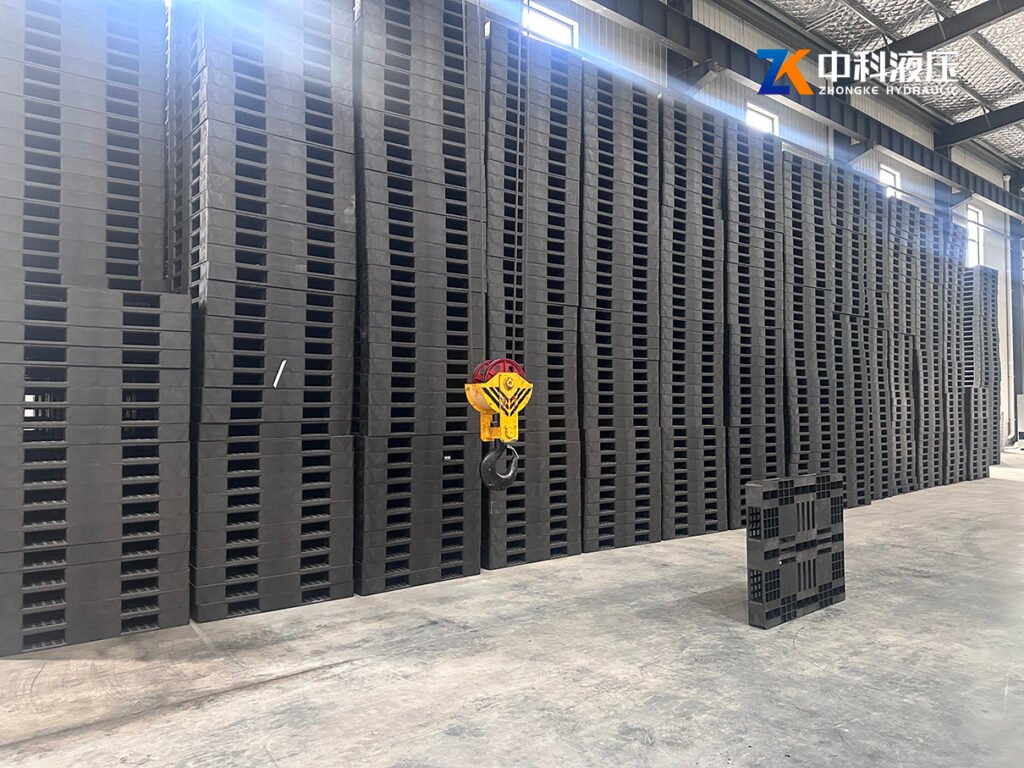
Two Reports, One Market, Very Different Numbers
Start with the spread. PW Consulting’s global recycled plastic pallet market report values the market at $1.55 billion in 2025. It projects $2.67 billion by 2032, an 8.12% CAGR. QYResearch’s separate 2026 report starts from a bigger base: $2.98 billion in 2025. Its 2032 target is $3.78 billion, at just 3.5% a year.
Same product category. Same forecast window. The 2032 targets sit within $1.1 billion of each other. The growth rates differ by more than two times.
The divergence is mostly a scope question, not a market question. One report counts pallets marketed with any recycled share. The other applies stricter content thresholds and narrower regional coverage. Compression-moulded pallets from mixed waste fall between those definitions. Many of them contain 100% recyclate, yet they sell through channels the surveys never reach. Neither number is wrong. Neither is precise enough to run a business on.
Where the Reports Agree — and Why That Agreement Matters
The overlap is where the buying signals hide.
HDPE leads the material split. PW Consulting puts HDPE at 59.1% of 2025 revenue. A separate plastics-pallets analysis by Deep Market Insights reaches a similar conclusion from the virgin side, with HDPE near 68%. HDPE tolerance is not optional when you specify a line.
Europe is the largest regional market. PW Consulting values the European segment at $506.5 million for 2025. That matches what European buyers actually ask for: verified recycled content, documented batches, and PPWR-aligned specifications.
Nestable designs take 41% of demand. Food and beverage is the largest end use at 36%. Both figures point at one-way and light-duty logistics, not heavy racking. That detail decides your mould, your cycle time, and your pallet weight target.
The price advantage is quantified. QYResearch quotes FOB prices from China of $4.50–9.50 per piece for light-duty recycled HDPE pallets. Heavy-duty export versions run $15–30. Both bands sit 20–40% below virgin-plastic equivalents. Those numbers set the revenue ceiling for any line you commission.
Both reports also name the same constraint: recycled feedstock quality. Batch-to-batch variation, moisture, and contamination limit what buyers accept. On this point the researchers and the machine builders agree completely.
What the Numbers Mean for a Line Buyer
Translate the forecasts into operating numbers and the picture sharpens.
A 1,800-ton press running 15–20 pallets per hour produces roughly 250–300 pallets per shift. At 21–25 kg per pallet, that line consumes 5–7 tonnes of feedstock a day. At the QYResearch price bands, a shift of light nestable pallets carries $1,100–2,800 of FOB revenue. Feedstock cost, not demand growth, decides how much of that survives.
November’s recycled polymer prices support that read. European recyclers rolled over rHDPE and rPP prices into November, ahead of the EU’s 21 November export ban. Regenport’s week-two market report documents cost pass-through on energy and diesel in week one, even as Q4 demand stayed weak. Spain’s PET bale glut cleared some auction lots at effectively negative values once handling costs were counted. Cheap feedstock is arriving in Europe. Converting it into a $9.50 pallet is where the margin sits.
There is a quieter signal in the market chatter too. One recycler told Regenport that PPWR obligations have had limited impact on recycled uptake so far. Regulation will pull demand eventually. In 2026, the pull is price.
The Cost Stack Behind a $9.50 Pallet
Price bands set revenue. Costs decide how much survives. Four lines make up the stack on a moulded pallet.
Feedstock comes first, and it is the biggest swing. Mixed rigid scrap is the cheapest polyolefin stream in Europe, and the bale glut pushing Spanish PET auctions below zero says the same thing louder: material without a buyer is nearly free to whoever can use it. A clean, sorted flake costs several times more per tonne than a mixed industrial stream. On a 21–25 kg pallet, that choice alone can move material cost by $2–4 per piece.
Energy comes second. A compression line draws roughly 2–3.5 kWh per pallet once the extruder, heaters, and auxiliaries are counted. At Eurostat’s H1 2026 EU industrial average of €0.18 per kWh, that lands under €0.65 per pallet. In Germany, at more than double the average tariff, it is the same line with a thinner margin. Energy is rarely the deciding cost. Feedstock is.
Tooling comes third, and it is smaller than most buyers expect. A P20 mould rated for 300,000 cycles spreads its cost over three years of two-shift production. Amortised, it is a few cents per pallet. What actually hurts is downtime while a second mould is on order, not the mould itself.
Metering is fourth, and it is the invisible one. Weight variation across consecutive shots is what separates a line that holds spec from one that quietly gives away 300 grams of resin per pallet. Over 250 pallets a shift, poor dosing burns feedstock money that never appears on any quotation.
Which Forecast Should You Plan Against?
Neither. Plan against the agreement instead, and run both growth rates as scenarios.
If the slow 3.5% forecast holds, the European segment adds roughly $18 million a year. Most of that demand comes from replacement and from recyclers moving downstream, not from market expansion. If the fast 8.12% forecast holds, Europe adds about $41 million a year. The entrant profile barely changes: it is a company that already holds a waste stream and wants to convert it. The forecasts disagree about speed. They agree about who wins.
That is why the equipment decision looks the same under both scenarios. A buyer who controls 5–7 tonnes of daily feedstock can run a line profitably at either growth rate. A buyer waiting for the market to pull them in can wait through both forecasts and still have no material.
The Practical Read
Do not buy a CAGR. Buy three things the forecasts agree on.
First, a feedstock position. The spread between 3.5% and 8.12% reflects how much cheap mixed waste each forecast assumes gets converted. A contracted waste stream is the asset. The press is just the converter. Our plastic pallet molding machine page breaks down the full flow from shredding to demoulding. Our ZK-1800 recycled plastic pallet press runs 15–20 pieces per hour on a 58-tonne frame, and the feedstock guidance in the palletsbiz guide to recyclable plastics and pallets covers which streams are worth contracting.
Second, the nestable, HDPE-tolerant specification. It is 41% of the market and fits the light-duty price band. A P20 mould rated for 300,000 cycles amortises to cents per pallet across that volume.
Third, metering discipline. Both reports flag batch variation as the industry’s core weakness. Pallet weight variation across consecutive shots tells a buyer whether your dosing system works. We weigh every trial run. The recent Philippines order for twelve ZK-1600 presses was signed only after the delegation ran its own flake on our press.
Competitors are reading the same forecasts. PalletMach is publishing compression guides on a second domain. ThoYu just posted a Polish recycler running 100% mixed PP/HDPE flake through a 1,600-ton press at 20–27 kg per pallet. The research houses will argue about CAGRs for years. The feedstock conversion race has already started.
If you want to pressure-test these numbers against your own waste stream, send us your flake for a trial. We return the pallets, the pressing parameters, and the weight-variation record.