
Short answer: ISPM 15 exemption and EUDR exemption are two different tests. The molded pallet trade keeps treating them as one. A presswood pallet is outside ISPM 15 because it is processed wood. That says nothing about the EU Deforestation Regulation. Under EUDR the deciding question is whether your fiber was waste or a by-product. The European Commission has already answered that question for sawmill sawdust, in writing.
Forty-eight days. That is the gap between today and 30 December 2026. From that date the EUDR applies to large and medium operators placing wood products on the EU market. No further postponement is coming. Brussels confirmed that after two delays. Carriers have begun issuing customer advisories carrying the same sentence.
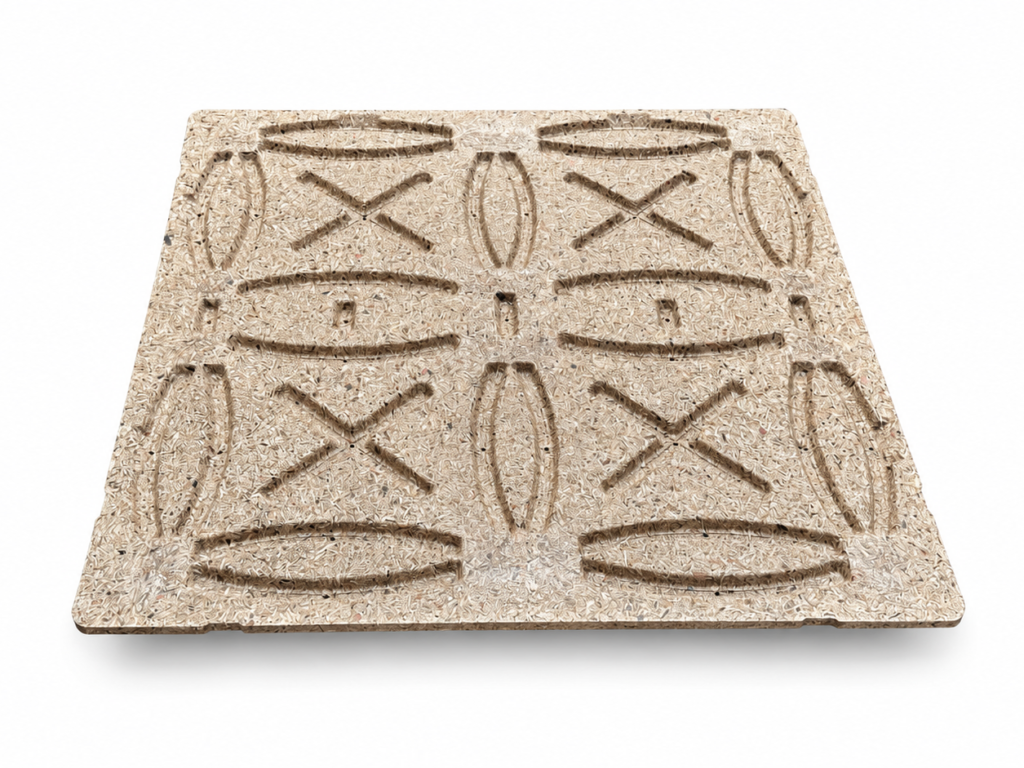
So the question lands on every molded pallet producer who sells into Europe: does this rule touch us?
Two tests, one adjective, a lot of confusion
ISPM 15 asks whether a packaging component is raw wood or processed wood. Ground fiber, resin, heat and clamp force produce something that is not raw wood. The standard does not reach it. No mark, no fumigation, no treatment facility number.
EUDR asks a completely different question. It asks where the wood came from, and whether the land it came from was forested on 31 December 2020. It also asks whether the material entered the economy as virgin harvest or as something already discarded.
A pallet can pass the first test and fail the second. That is the whole problem. Search the molded pallet category and the phrase “EUDR-exempt” shows up everywhere. It is used as though it followed automatically from “ISPM 15 exempt.” It does not follow. It is a separate finding, established from your fiber supply, batch by batch.
What the Commission actually wrote about sawdust
Here is the paragraph that should be pinned above every purchasing desk in this industry. The Commission’s guidance document for Regulation (EU) 2023/1115, published as C/2024/6789, contains a direct question and a one-word answer.
Are wood chips and sawdust produced as by-products of sawmilling subject to the Regulation? Yes. They fall under HS code 4401, which is in scope. The reason: they may be used as fuelwood, so they have not completed their lifecycle.
Read that twice. Sawmill dust is not waste in the legal sense. It is a by-product of a manufacturing process that handles material still inside its economic life. Under EUDR, by-products stay in scope. Only material that has genuinely finished its life, and would otherwise be thrown away, drops out.
That single answer redraws the map for our industry. A 1,600-ton press at 900 kg/m³ and 180–240 seconds per cycle changes the fiber physically. It cannot change its legal character. The press does not turn a by-product into waste.
Where the waste line actually falls
The same guidance sets out the other side of the line. Goods made entirely from material that has completed its lifecycle, and would otherwise have been discarded, are outside the regulation. Demolition timber is the example Brussels gives. End-of-life furniture and discarded pallets sit in the same category.
Then come the two clauses that catch people.
First, any non-recycled content pulls that portion back into scope. The guidance names timber used to repair pallets as an example. Mix recycled board with a virgin runner and the product splits. One part is clean. One part is not. You now need evidence for the dirty part.
Second, mixed batches do not inherit the exemption. A silo holding demolition fiber and sawmill dust together is not “mostly recycled.” It is mixed. The in-scope fraction needs documentation.
For a molded pallet line this is not an abstract debate. It is a question about the front end of the plant. Crusher, screener, metal removal, dryer. A line built for clean sawmill dust is not the same machine as one built for demolition wood. The press at the end can be identical. The front end cannot. The second one buys you a fiber story the first one cannot tell.
We have tested the boundary from the other side too. Reed-based fiber went through the same press platform, to see where substitution holds up. Different fiber, same physics, and the same question about origin paperwork.
What changed in September 2026
The perimeter moved twice this year, which is why a 2025 compliance assessment is now dangerous to rely on.
The September 2026 delegated act, Regulation (EU) 2026/2102, amended Annex I of the EUDR. It added a short list of products from 30 December 2027. That list includes soluble coffee and some palm oil derivatives used in oleochemicals. It also wrote out a list of exemptions. That list covers waste, used and second-hand products, packaging material, marketing and information material, items of correspondence, and samples.
Packaging material. That word matters enormously to anyone shipping pallets.
The reading most customs brokers now apply is this. A pallet travelling as packaging, there only to carry and protect somebody else’s goods, falls inside the packaging exemption. A pallet sold as a pallet is different. It is invoiced as a product with its own commercial identity. It is a wood product in its own right, and it does not get the packaging treatment.
That is the dividing line. It is worth a written answer from your broker, not an assumption from a trade magazine. Note also that this exemption arrived in September 2026. It may not have existed when your last EUDR memo was written.
What happens at the gate
Enforcement is not theoretical. The Due Diligence Statement reference number is filed in TRACES, and the customs declaration has to quote it. Where the reference is missing or invalid, the declaration cannot be validated and the goods are not released.
The cost of that is demurrage and detention, on top of the penalty regime. Under Article 25, fines must reach at least 4% of the operator’s total annual EU turnover. Confiscation of goods and revenue is on the table. So is temporary exclusion from public procurement.
Records have to be kept for five years. Geolocation data has to be precise to six decimal places in WGS84, with polygons for plots above four hectares. Country risk bands set inspection intensity at 1%, 3% or 9% depending on where the fiber originated.
None of that is aimed at pallet makers. It is aimed at whoever first places the product on the EU market, which is usually the importer. But the importer cannot file without supplier data. A supplier who cannot produce plot-level origin for the fiber becomes a supplier with a problem.
The file a molded pallet buyer will ask for
Five documents do most of the work, and none of them require new equipment.
A fiber origin declaration per batch. Species, supplier, country and region of harvest. If the fiber is post-consumer, say so and name the source stream.
A waste-status statement where you are claiming the exclusion. Recycled content has to be evidenced as having completed its lifecycle, not asserted. Photographs of incoming demolition wood are cheap and persuasive.
A bill of materials with the binder separated out. The resin is not wood and is not in scope. UF and MF systems run at 10–15% add-on. MDI runs at 4–5%. Stating the type also answers the formaldehyde question that follows.
Process parameters. Platen temperature, clamp force, dwell time, mold identifier. These do not decide EUDR status. They decide whether an inspector believes the pallet is one pressed component, not assembled timber.
A batch-to-buyer map. Which pallet went into which shipment, and which fiber batch it came from. This is the document that saves a container. It turns a general claim into a traceable one.
Why this is an opportunity, not just a cost
The molded wood pallet market was around USD 2.3 billion in 2026. Future Market Insights projects USD 4.1–4.2 billion by 2036, at roughly 6.1% compound growth. A good part of that growth comes from buyers fleeing the paperwork around solid wood. Those buyers should not discover, in January 2027, that molded pallets carry paperwork of their own.
Better to be early. A producer who can hand an importer a fiber file in Q1 2027 wins accounts. The competitor loses them at the border. That is a commercial advantage worth more than a small price difference.
There is a technical angle too. Waste-grade fiber needs a heavier crusher and magnetic separation ahead of the mill. Drying capacity has to be sized on evaporation, not silo volume. Those are the same components that make post-consumer fiber viable, and post-consumer fiber is the cleanest EUDR story available. Our presswood pallet machine page covers the platform. The sizing detail lives in the production capacity calculation, which most projects skip.
The production overview on palletsbiz sets ISPM 15, PPWR and fiber economics in one frame. Spanish-speaking exporters shipping coffee, cocoa or soy into the EU face the same deadline. Their competent authority is a different one. The Spanish edition of this site carries the machine specifications in that language.
If you are still choosing fiber, the practical test is simple. Send the material you actually intend to run, dirty grades included. We will press it and tell you what the file would look like. Start with a conversation about your fiber rather than a quotation. The fiber decision outlasts the machine decision by a decade.
The part nobody wants to hear
The molded pallet industry has spent years selling one exemption. It now has to sell a second one, or admit it does not have it.
Sawmill dust is in scope. That is not an interpretation, it is the Commission’s own answer to its own question. Demolition wood and end-of-life pallets are out of scope, provided the batch is genuinely clean and the evidence exists. The gap between those two positions is the entire EUDR exposure of a presswood plant. It is decided in the yard, before anything reaches the mold.
Buyers will figure this out. Some already have. The questions arriving from European importers have changed. Nobody asks whether the pallet is ISPM 15 exempt any more. They ask where the fiber came from. Answer that second question well and the first one stops mattering.
—
Need the paperwork itself? The five templates live in the EUDR Fiber Origin File pack — free, fill-in, and downloads the moment you submit the form.