
Presswood pallet machine production capacity is one of the most important factors to evaluate before investing in a molded pallet production line. However, a machine’s rated output is not necessarily the number of finished, acceptable pallets a factory can produce during a shift.
Actual output depends on cycle time, mold configuration, raw material preparation, adhesive application, equipment availability, product changeovers, and quality yield. Understanding these variables helps manufacturers compare equipment quotations, plan factory capacity, and set realistic production targets.
This guide explains how to calculate theoretical output, estimate practical production, identify bottlenecks, and verify a presswood pallet machine’s performance during commissioning.

1. Understand the Three Types of Production Capacity
Before comparing machines, establish exactly what the quoted production figure represents.
Theoretical production capacity
Theoretical capacity is the output calculated from the number of pallets produced per cycle and the average cycle time.
It assumes continuous operation under the stated conditions without accounting for unscheduled downtime, material shortages, or rejected products.
Scheduled production capacity
Scheduled capacity is the theoretical output during the hours allocated to production. It depends on the planned operating schedule.
For example, an eight-hour shift has fewer scheduled production hours than a machine operating continuously across multiple shifts.
Actual accepted output
Actual accepted output is the number of pallets that meet the agreed product specification.
It accounts for production interruptions and quality losses. This is the most useful figure when evaluating whether a machine can meet a customer’s delivery requirements.
When requesting a quotation, ask the supplier to identify which of these three figures is being provided.
2. Calculate Theoretical Hourly Output
The basic calculation is:

For a machine producing one pallet per cycle with a four-minute cycle:
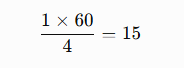
The theoretical output is 15 pallets per hour.
This is a mathematical example, not a guaranteed output for any particular machine. Actual cycle times depend on the product, raw material, mold, process settings, and operating conditions.
If a mold produces multiple pallets per cycle, the calculation must use the actual number of acceptable pallet positions filled during that cycle. Do not assume that a larger mold or a higher-tonnage press automatically increases output.
Measure cycle time consistently
For production planning, define the cycle consistently, such as the elapsed time between the start of consecutive molding cycles.
Record the following stages where applicable:
- Mold closing and material compression
- Heating and curing or holding
- Mold opening
- Pallet removal
- Material charging and preparation for the next cycle
Some stages may overlap in automated systems. Avoid adding overlapping durations together as if they occurred sequentially.
A production cycle should be measured on the actual equipment using the intended product and material, not inferred solely from the press’s rated pressure.
3. Convert Hourly Capacity Into Practical Shift Output
A simple way to estimate practical production is to account for equipment availability and quality yield.
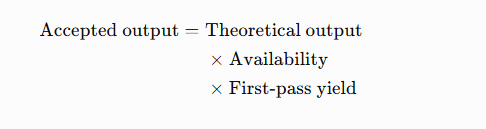
Where:
- Theoretical output is the output possible during scheduled production hours at the measured cycle time.
- Availability is the proportion of scheduled time during which the machine is available for production.
- First-pass yield is the proportion of produced pallets accepted without rework.
Availability and first-pass yield must be calculated from actual production records. They are not universal constants for presswood pallet machinery.
Worked example
Consider a hypothetical production line with the following planning assumptions:
| Parameter | Example value |
|---|---|
| Pallets per cycle | 1 |
| Average cycle time | 4 minutes |
| Scheduled production time | 8 hours |
| Equipment availability | 85% |
| First-pass yield | 97% |
First, calculate theoretical output:

Theoretical shift output is 120 pallets.
Next, account for availability:

Estimated production after downtime is 102 pallets.
Finally, account for first-pass yield:
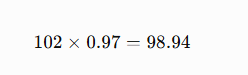
The estimated accepted output is approximately 99 pallets per shift.
Important: These figures are illustrative planning assumptions, not measured ZK Hydraulic production results. If the measured cycle time already includes all downtime across the shift, availability must not be applied a second time.
4. Identify the Main Factors That Affect Cycle Time
A presswood pallet machine is only one part of the production process. Its performance depends on the interaction between material preparation, mold design, heating, hydraulic operation, and finished-product handling.
Raw material preparation
Wood chips, sawdust, rice husks, straw, and other biomass materials may require different crushing, screening, and drying conditions.
Variable moisture content or particle size can change material flow, mixing behavior, and molding consistency. If the feedstock is not prepared consistently, the press may need more process adjustments and quality inspections.
Review the PalletsBiz raw material guide and its guide to moisture content in molded pallet manufacturing when evaluating a new feedstock.
Adhesive application and curing
The binder system and its compatibility with the raw material affect how the mixture is prepared and processed.
Adhesive dosage, mixing uniformity, material moisture, and the required curing conditions must be evaluated together. A cycle that works for one formulation should not automatically be transferred to another.
The PalletsBiz comparison of UF, MUF, and MDI adhesives provides background for selecting an appropriate binder system.
Mold geometry and heating
The pallet’s dimensions, structural features, wall thickness, and mold geometry can influence filling, heat transfer, and demolding.
A mold that produces a simple nestable pallet may have different cycle requirements from one designed for a more complex double-deck pallet.
Mold temperature uniformity and reliable release are important to maintaining repeatable production. Shortening the cycle without verifying product quality can increase rejected output rather than improve useful capacity.
For machine and tooling selection, review the ZK Hydraulic presswood pallet machine range and its custom pallet mold capabilities.
5. Check Whether the Whole Production Line Can Keep Up
A press may have sufficient theoretical capacity while the complete production line cannot supply it with prepared material or remove finished pallets quickly enough.
Typical production-line stages include:
- Raw material receiving and storage
- Crushing and screening
- Drying, where required
- Adhesive mixing
- Material metering and charging
- Hydraulic molding
- Demolding and finished-pallet inspection
- Stacking and finished-goods handling
Each stage must be evaluated using compatible production units, such as kilograms of prepared mixture per hour or accepted pallets per hour.
The slowest effective stage can become the production bottleneck.
For example, increasing press speed will not necessarily increase total output if the mixer cannot prepare enough consistent material or the dryer cannot supply the required feedstock.
A balanced production line should be designed around the intended product mix, raw material, shift schedule, and required finished output.
6. Account for Product Changeovers and Planned Stops
Factories producing several pallet designs may lose production time when changing molds, adjusting settings, cleaning equipment, or switching materials.
These losses should be included in production planning rather than hidden inside an optimistic hourly rate.
Record:
- Changeover frequency and duration
- Mold installation and adjustment time
- Material changeover and cleaning time
- Planned maintenance
- Unplanned downtime
- Inspection and quality-control time
If a factory makes several pallet models in one shift, calculate output for each product separately before combining the results.
A machine may achieve its best cycle time on one pallet design but require a different cycle for another. A reliable quotation should identify the product configuration used for the stated production rate.
7. Verify Production Capacity During Commissioning
Before accepting a production-line capacity claim, agree on the conditions under which performance will be measured.
A useful commissioning plan should define:
- The exact pallet drawing and dimensions
- The raw material and its moisture condition
- The adhesive type and dosage basis
- The mold configuration
- The cycle-time measurement method
- The planned production duration
- The acceptable quality criteria
- How rejected products and downtime are recorded
Run repeated production tests using representative material batches rather than relying on a single successful cycle.
Measure both the number of pallets produced and the number accepted after inspection. Record any process adjustments made during the test.
For pallet load performance, use an appropriate test plan based on the intended application. ISO 8611-1:2025 describes test methods for evaluating new flat pallets, including nominal-load, maximum-working-load, and durability-comparison testing. The standard also makes clear that load-capacity tests do not replace field testing of specific pallet designs.
Production output and product performance are separate acceptance criteria: a machine can achieve a high cycle rate while still producing pallets that fail the customer’s specification.
8. Compare Machine Quotations on the Same Basis
When comparing suppliers, do not compare hourly production figures without checking the underlying conditions.
A practical comparison should include:
| Evaluation item | Questions to ask |
|---|---|
| Machine capacity | What is the rated press capacity, and what does it mean for the selected pallet? |
| Cycle time | Is the stated cycle based on an actual production test? |
| Mold configuration | How many acceptable pallets are produced per cycle? |
| Raw material | Which feedstock and moisture conditions were used? |
| Production schedule | How many operating hours are assumed per shift or day? |
| Automation | Which charging, removal, stacking, and handling tasks are automated? |
| Quality yield | Is the output figure based on total production or accepted pallets? |
| Testing | Can the supplier document output and product quality under agreed conditions? |
This comparison makes it easier to identify whether a lower quotation reflects a genuinely suitable production solution or simply uses different assumptions.
9. Estimate the Cost per Accepted Pallet
Production capacity matters because it affects unit cost, but output alone does not determine profitability.
A useful starting formula is:

The cost model should include raw material, adhesive, energy, labor, maintenance, rejected products, and other relevant operating expenses.
If a machine produces more pallets per hour but consumes more energy, requires additional labor, or generates more rejects, its cost per accepted pallet may not improve.
Likewise, a lower hourly rate may still be commercially attractive if the line operates reliably and consistently meets the required product specification.
Use measured production data wherever possible. Treat estimates as estimates until commissioning and normal production records establish the actual figures.
Conclusion
Presswood pallet machine production capacity should be evaluated through measured cycle time, scheduled operating hours, equipment availability, and first-pass yield.
Theoretical output is useful for initial equipment comparisons, but actual accepted output is the figure that matters for delivery planning and cost calculations.
Before purchasing a production line, establish a common measurement method, confirm the raw material and mold configuration, evaluate the entire production process, and agree on the criteria for commissioning and quality acceptance.
For manufacturers planning a new project, ZK Hydraulic can assess the relationship between the selected press, pallet mold, raw material, and production requirements. The goal is to choose a configuration that can produce the required quantity of acceptable pallets consistently, rather than simply selecting the machine with the largest nominal pressure or the most attractive headline production rate.