
The short answer, stated once so it can be quoted: what decides whether a press can make a given pallet is not its tonnage, it is the specific moulding pressure — the force that actually reaches the mould, divided by the projected area of the mat inside it. A 1,600-ton press closing on a 1.44 m² mould lands around 9 MPa at the face. The same press on a 0.96 m² mould lands near 13 MPa. Identical machine, identical invoice, two different products — and the first one will finish at 850 kg/m³ however long you hold it under pressure.
That relationship explains most of the confusion in this category. Nearly every quotation states a cylinder rating and nothing else, so buyers pick the bigger number — then discover in month two that the second pallet on their sales sheet needs a new mould and more force than the frame can deliver.
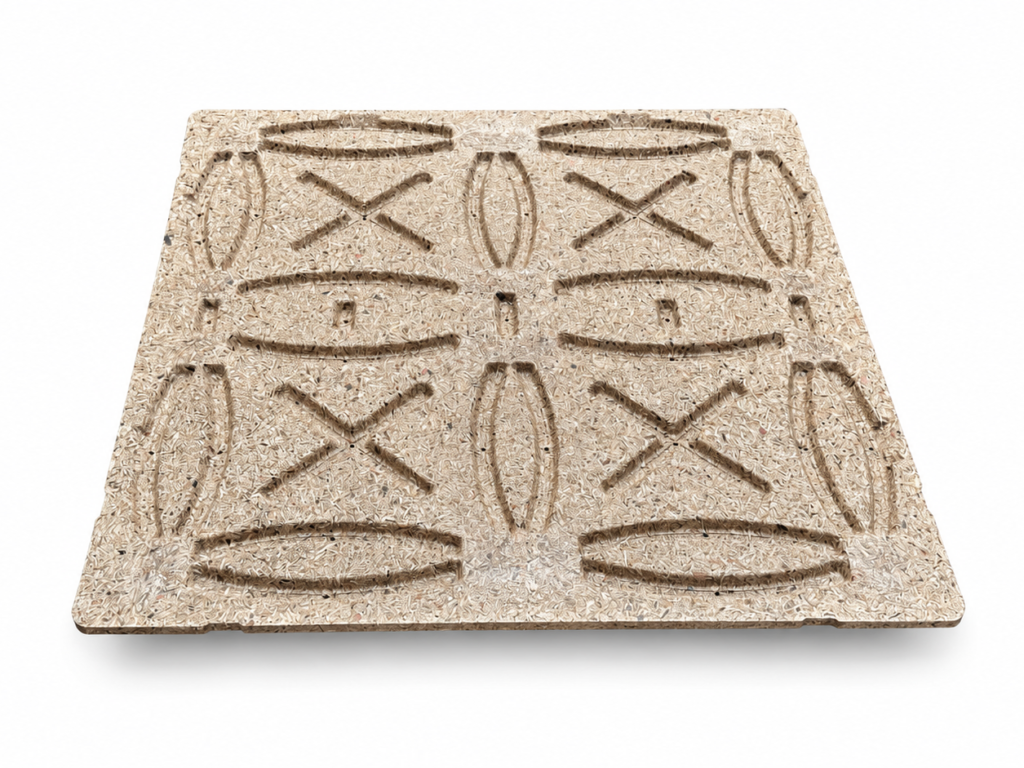
Why two suppliers quote the same pallet at 1,250 tons and 1,600 tons
This morning a competitor posted a plant visit in which a Turkish furniture maker pressure-tested its own sawdust on a 1,250-ton press and left with a quotation. A rival’s homepage, checked the same morning, advertises a 500–1,600 ton range with 150–180 °C mould temperature, 15–20 MPa at the face, 180–240 second cycles and platens up to 2,500 × 1,700 mm. Both are describing the same 1,200 × 800 export pallet. Neither is lying.
Three things move the number.
The first is rated versus delivered force. A cylinder rated at 1,600 tons does not put 1,600 tons on the mat. System losses, pack pressure and the ejector circuit take a bite; 75–85% of rated is the honest planning figure, so a “1,600-ton” frame behaves like 1,300 tons where the fibre is. A supplier quoting 1,600 tons and another quoting 1,300 tons of working force may be selling the same machine.
The second is the density target. At 900 kg/m³ a pallet is a competent export platform. At 1,000–1,050 kg/m³ it takes edge impact, resists water uptake and survives a racking aisle. Different products, different pressures. Our own line work puts a 1,000-ton press at 800–850 kg/m³, a 1,250-ton at 900–950, and a 1,600-ton at 1,000–1,050 on a standard 1,200 × 800 nine-leg — figures that only mean something alongside the resin and the moisture that went in.
The third is the resin system. Market research updated on 23 October puts urea-formaldehyde and melamine-reinforced binders at 68.7% of 2026 demand, curing in 5–7 minutes of hot-press time. MDI runs faster, 3–5 minutes, and tolerates wetter fibre, at a higher cost per kilogram and with a mould-sticking problem that needs automatic release-agent spraying. Faster cure means less heat soak per cycle, which changes what a given tonnage can hold.
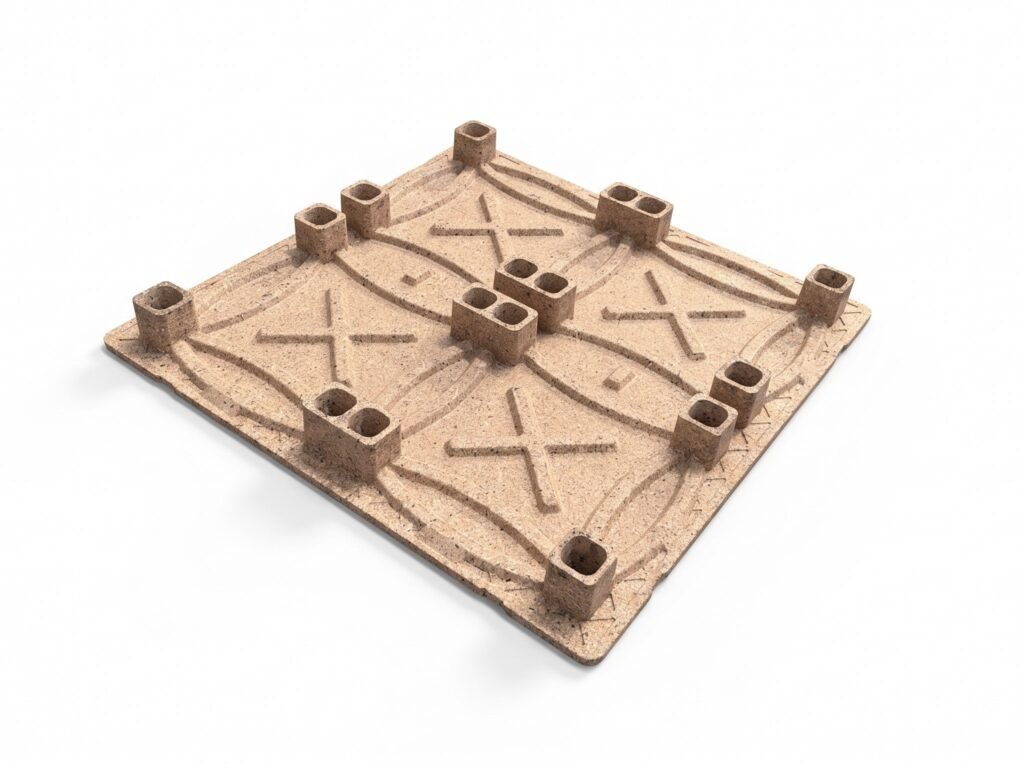
The four numbers that actually bind
Tonnage is one of four constraints. The other three sit on the specification sheet, and almost nobody reads them together.
Platen size. A mould needs clearance for clamps and for its own frame — 150 to 200 mm per side. A 2,000 × 1,500 mm table therefore takes a single mould up to roughly 1,700 × 1,200 mm at the tight end of that clearance, and only 1,600 × 1,100 mm at the generous end. A 1,200 × 1,200 pallet mould is 1,200 mm on its short side, which needs 1,500 mm of table at minimum clearance: the table, exactly, with nothing left over. No builder will guarantee clamp-up on a mould that fills the platen edge to edge.
Daylight, or maximum opening. The ZK-1600 class frame opens to 1,200 mm on a 700 mm stroke. A 125 mm nine-leg pallet plus a two-part mould sits comfortably inside that. A 150 mm flat-deck design with deep ribs and a counter-pressure ejector does not always. A stacked two-cavity tool never does.
Stroke. Ejecting a deep-leg mould needs travel, not force. Short-stroke frames are cheaper and press pallets happily until the day you want a drum pallet with 135 mm feet.
Mould count. One mould is one footprint. A second size is a second tool — H13 steel, 48–52 HRC, rated for 250,000–300,000 pressings, which is two to three years of single-shift work. It is a capital purchase of its own, not a line option, and it is where “we’ll add 1,200 × 1,000 next year” usually breaks.
Put the four together and the sizing table stops being mysterious.
| Footprint | Mould area | Rated tonnage for 900–1,000 kg/m³ | Typical unit mass |
| 800 × 600 | 0.48 m² | 800–1,000 t | 8–10 kg |
| 1,200 × 800 | 0.96 m² | 1,250–1,600 t | 13–15 kg |
| 1,100 × 1,100 | 1.21 m² | 1,600–2,000 t | 16–18 kg |
| 1,200 × 1,000 | 1.20 m² | 1,600–2,000 t | 17–19 kg |
| 1,300 × 1,100 | 1.43 m² | 2,000–2,500 t | 20–24 kg |
| 1,200 × 1,200 | 1.44 m² | 2,000–2,500 t, wider table | 20–25 kg |
Read the last row twice. A 1,600-ton press with a 2,000 × 1,500 table is under-pressured for a 1,200 × 1,200 pallet and, at normal clamp clearance, over-size as well. Two failures a tonnage comparison hides completely.
The catalogue sheet that cannot be true
A Chinese catalogue listing circulating this month offers 1,250 t, 1,600 t and 1,800 t models, then lists seven footprints from 1,050 × 1,050 up to 1,300 × 1,100 — every one at 2,500 kg dynamic and 6,000 kg static. The largest carries 30% more mould area than the smallest. It cannot hold the same load at the same density on the same press. Either the small one is over-built or the big one is a wish.
This is the pattern buyers keep walking into: ratings copied down a column because sales wrote the sheet, not the process engineer. The defence is boring. Ask for the load figure together with the footprint, the density, and the standard it was tested to. ISO 8611-1, in its fourth edition since February 2025, is what makes those numbers comparable — nominal load, maximum working load, durability, each with its own test. A figure without a test method attached is a figure from a brochure.
Load in service is not one number either. The pallet that carries 1,500 kg dynamic in a stack can be unusable in unsupported open-beam racking, where the deck spans between two beams and must hold 24 hours without creeping past 2% of its length. Reinforced bottom deck or no racking claim — no tonnage changes that.
And since the exemption is usually why the press is being bought: the IPPC’s ISPM 15 text covers packaging made from raw wood and expressly excludes wood processed in a way that leaves it pest-free — the regime the USDA APHIS wood packaging page enforces on the way in. No tonnage buys that exemption. The process does.
Where the money actually goes wrong
Here is the opinion: most buyers over-buy tonnage and under-buy drying.
Fibre at 50% moisture will not reach 900 kg/m³ at any pressure you can afford. The target is 8–12% before the mat former, and getting there from green sawdust means removing close to 890 kg of water per dry tonne — roughly 1,000 kWh of dryer heat, or $80–120 per dry tonne in fuel, before anyone discusses the press. Plants that size the press carefully and the dryer casually end up running 1,600 tons to make an 850 kg/m³ pallet, then blame the machine.
The market does not reward that mistake. The 1,200 × 800 nested pallet holds 58.9% of 2026 volume, and medium-duty units hold 45.3% — the sizing question is already settled for most of what the world buys. The money sits in the second and third footprint, where tooling, platen width and drying capacity all land in the same quarter.
What to ask before anyone quotes you a tonnage
Four questions, in this order.
What is the delivered force at the mould, not the cylinder rating — and what projected mat area did you base it on? Then: what platen comes with that frame, and what is the largest mould footprint you will guarantee clamp-up on? Then: what daylight and stroke, measured against the tallest pallet in my range rather than the thinnest? And finally: what density did you achieve on my material, at my moisture, on the size I actually want to sell?
A supplier who answers the fourth with a test report rather than a payback period is the one worth visiting. The rest are reciting a spec sheet.
One structural point belongs in that first conversation. The same three-beam four-column platform presses wood fibre and recycled plastic with a mould change, which is why dual-material plants have become the hedge of choice for export-facing producers. Ask early whether the frame takes a plastic tool later, and at what platen width — the presswood pallet machine range and the plastic pallet machine line share that architecture by design. A nailed assembly never will, which is the argument against the pallet nailing machine route once density and repeatability matter more than cost per board.
Who this fits, and who should keep buying pallets
A press makes sense above roughly 30,000 pallets a year, with a stable fibre stream, 600 m² of floor and six metres to the ceiling for mould handling. Below 10,000 pieces, buying finished pallets is cheaper and will stay cheaper — the tooling alone does not amortise. The middle band is where the tonnage decision actually decides the business case. Size for the pallet you can sell in volume, and add the second mould when the second customer signs rather than when the brochure suggests.
For this with real material behind it, the plant notes on our news page cover what specific frames achieved on reed fibre, sawmill chips and mixed agricultural residue — including trials that argued against the project. With a footprint in mind and a fibre stream in hand, the quickest way to settle the tonnage question is to send both to our engineers and ask what density they expect, rather than what press they would like to sell you.
The bottom line. Tonnage is a proxy, and a poor one. Pressure at the mould, platen width, daylight and stroke decide what leaves the die; resin and moisture decide whether it holds. Ask for those four numbers and the fifth — density on your own fibre — and quotations become comparable. Until then you are comparing cylinder sizes and hoping.