
Something odd surfaced in Range International’s September quarter report this week. The ASX-listed maker of Re>Pal zero-waste pallets delivered 33,181 units in Q3 — barely above Q2. But the number of pallets out on rental contracts climbed 19.6%, to 13,694. Two lines, one conclusion: the company buying molded recycled pallets and the company using them are no longer the same company.
Range put the arithmetic in its own filing. Rented pallets earned a weighted average of IDR 336 a day. Contracts averaged 37.7 months. The fleet sat across 11 locations with 7 clients. To replace the sales revenue of the past twelve months with rental income alone, the company calculated it would need 305,773 pallets in service.
That single figure explains why the pallet business is quietly splitting in two.
The definition, since “pooling” gets thrown around loosely
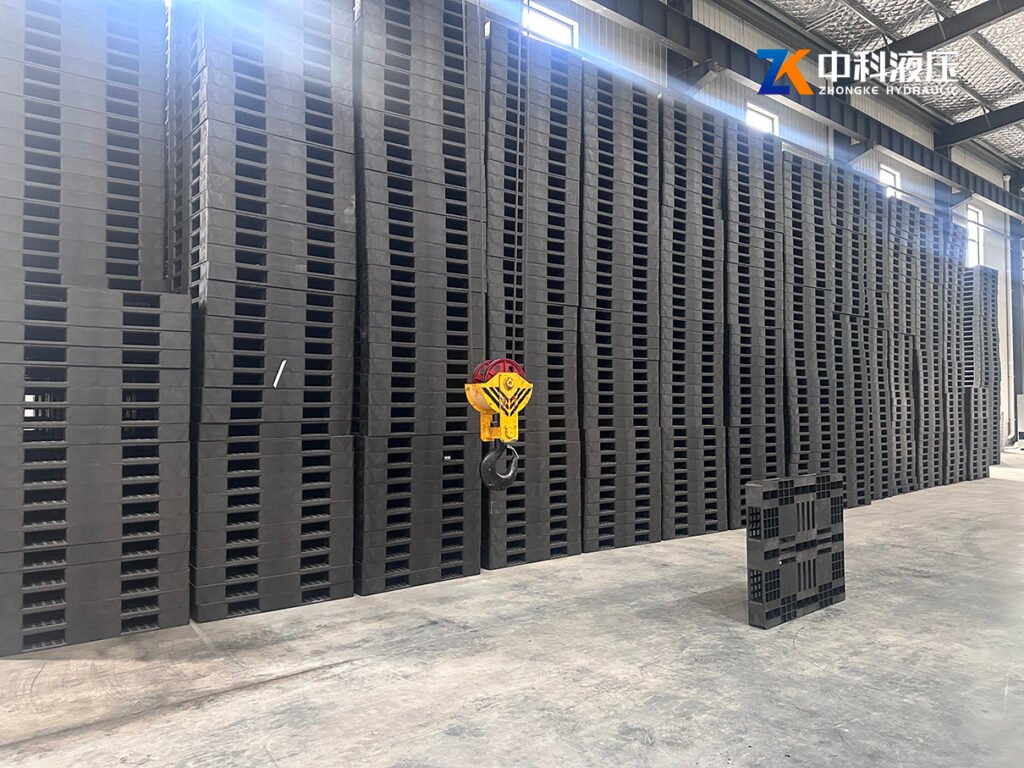
Pallet pooling means one operator owns a standardized fleet and charges users per trip, per day or per rotation, collecting damaged units for repair instead of selling them outright. The user never books a pallet as a fixed asset. The operator carries the capital, the reverse logistics and the repair bay.
Pooling stopped being a niche experiment some time ago. LEAP India runs roughly 9.2 million pooled pallets, which gives it about 90% of the country’s organized pooling market. Its own investor numbers show how much runway is left. Only 9.4% of Indian pallets sit in a pool, against roughly 45% in Europe and 55% in North America. CHEP EMEA booked US$2.35 billion of pallet revenue in the year to 30 June 2026. IFCO designs its crates for up to 120 uses before remanufacture.
Those are the buyers your molding line will be quoting to in 2028. Not the ones in the brochures.
In a sale, a pallet survives one journey. In a pool, it survives strangers.
This is the part that gets lost in machine catalogs. A one-way pallet has exactly one job: arrive intact. A pooled pallet has to come back, get stacked by someone who didn’t buy it, run through a wash tunnel, get welded by a technician who bills by the hour, and ship out again. For three years.
Design priorities flip hard. Deck cosmetics matter less than weldability. Impact strength at −18°C matters more than top-load stiffness, because cold-chain pools run freezer aisles and a pallet that shatters at the dock costs more than a pallet that flexes. Above all, a pool lives or dies on interchangeability. If a pallet molded in 2024 won’t stack square with one molded in 2026, the operator doesn’t have a fleet. They have two fleets and a sorting problem.
Range’s filing shows the tooling side of that pressure. A major Indonesian 3PL told the company its 2027 volumes would require a new mould and welding table, budgeted at about US$100,000. In a sales model, tooling is a one-time cost amortized across a product line. In a rental model, tooling is a recurring line item tied to fleet geometry — and the operator, not the pallet buyer, signs the check.
The arithmetic that decides whether you rent or sell
Here’s a rough calculation worth doing before you commit capital to either model. At IDR 336 a day, a rented pallet earns about US0.02 daily, or roughly US23 across a 37.7-month contract. That’s within spitting distance of what a 1200×1000 molded recycled pallet sells for outright.
Read that twice, because it reframes everything. Over a single contract term you collect roughly one sale price — and you still own the pallet, which can be rented again, and again, until the repair bay writes it off. The catch is timing. Rental revenue trickles in monthly while your press, your mould and your feedstock bill arrive all at once.
Range’s 305,773-pallet break-even number shows the scale problem plainly. At 480 pallets a shift — a realistic figure for a 23 kg pallet on a 60-second cycle — that fleet represents about 637 shifts of single-line output. Call it two and a half years of one press running flat out, with every unit shipped into your own asset base instead of a customer’s loading dock.
Very few plant owners can fund that. Most shouldn’t try. The model that works for a mid-size producer is a hybrid. Sell the bulk of output. Hold 10–20% back as a rental or exchange fleet, anchored to two or three customers who control their own return flows. That’s enough to learn the repair economics without becoming a logistics company.
Regulation has already picked a side
Europe settled this argument in law, and the clock is public. Under Article 29 of Regulation (EU) 2025/40, at least 40% of transport packaging must be reusable and inside a reuse system from 1 January 2030. For flows between a company’s own sites, or to another company in the same member state, the number is 100%. Pallets appear in the article by name.
That’s 39 months from today. Delegated Decision (EU) 2026/429, in force since 26 May 2026, pulled pallet wrap and straps out of the 100% rule, though both still count toward the 40%. The first reporting year is 2030, with submissions due by 30 June 2031. The Commission maintains an implementation timeline if you want the dates from the source rather than from a supplier’s slide.
One consequence is unavoidable. A shipper who has to hit 40% reuse cannot get there with one-way pallets, no matter what they’re molded from. They either join a pool or build a private loop. Both routes need pallets that come home, which means both routes reward durability over unit price.
Article 7 layers a second constraint on top. Plastic transport packaging needs documented recycled content — 35% by 2030 for non-contact-sensitive, non-PET formats, or 10% where the pallet is classed as contact-sensitive. Targets average per plant, per year, per format. A pool operator answering a customer’s sustainability questionnaire needs a paper trail with weighed tickets behind it, not a claim on a website.
What to spec differently when you’re standing in front of a press
Tonnage is the number buyers ask about first. It’s rarely the binding constraint for fleet work.
Cycle time sets your fleet build rate, and fleet build rate is what wins a pool tender. A 1,600–1,800 ton press running a 23 kg pallet on a 60-second cycle gives you roughly 480 units a shift, tested to 2,000 kg dynamic and 6,000 kg static under ISO 8611. Two cavities on a dual-station recycled plastic pallet press nearly double that without doubling floor space. We built one because buyers kept asking for fleet volumes from a single footprint.
Mould life sets your replacement cost per SKU, and pools multiply SKUs. Our molds run 250,000–300,000 pressing cycles before retirement. Price that against the contract term you’re signing, not against a ten-year depreciation schedule that assumes one product forever.
Feedstock tolerance decides whether the fleet stays one fleet. Mixed post-industrial HDPE and PP shrink differently from batch to batch. A ±3 mm swing is invisible in a one-way pallet, and fatal in a racked pool where units from three plants have to interlock. This is where cheap lines fail quietly. The first thousand pallets pass inspection. The tenth thousand doesn’t, and by then the operator has a customer complaint and a sorting crew.
We test every incoming material stream on a real mold before quoting — reed fiber, cable scrap, paper-mill mixed plastic, whatever arrives on a pallet in the yard. The plastic pallet machine page lists the configurations that came through those trials, and the same press platform runs presswood lines for plant owners hedging across two waste streams.
Competitor watch: everyone is still selling machines
ZZCHRYSO published a rotary dryer guide on 30 October — its first pallet-adjacent piece since August, after two months of furniture coating articles. PalletMach is still working Canton Fair follow-ups from mid-October. ThoYu hasn’t moved past product-page edits since 25 October. PalletMach’s second site, woodpalletmachinery.com, still surfaces 2021 holiday notices alongside this month’s fair recap.
None of them is writing about fleet economics, contract terms or repair loops. That’s the opening. Any supplier can quote tonnage and a delivery date. Almost none can tell a pool operator what their pallet will look like after forty trips through a wash tunnel, or what the fifth repair costs.
The uncomfortable conclusion
If you’re commissioning a plant in 2027, the buyer across the table is more likely to be a rental operator, or a shipper under a 40% reuse obligation, than a factory restocking consumables. That buyer doesn’t ask what a pallet costs. They ask what it costs per rotation, and how many rotations it survives before the repair bay gives up.
Selling pallets is a margin business. Renting them is an uptime business. Different machine, different mould, different crew — and, increasingly, a different country.
If you’re weighing either model, send us your material and your target duty cycle. We’ll tell you what the line can hold, including the parts that argue against your plan. Project notes and trial reports sit on our news page.