
The global molded presswood pallet sector is shifting from niche export packaging toward mainstream logistics infrastructure. Recent material trials, fair feedback, and market data all point to the same opportunity: turning locally available agricultural residues into consistent, ISPM-15-friendly molded pallets.
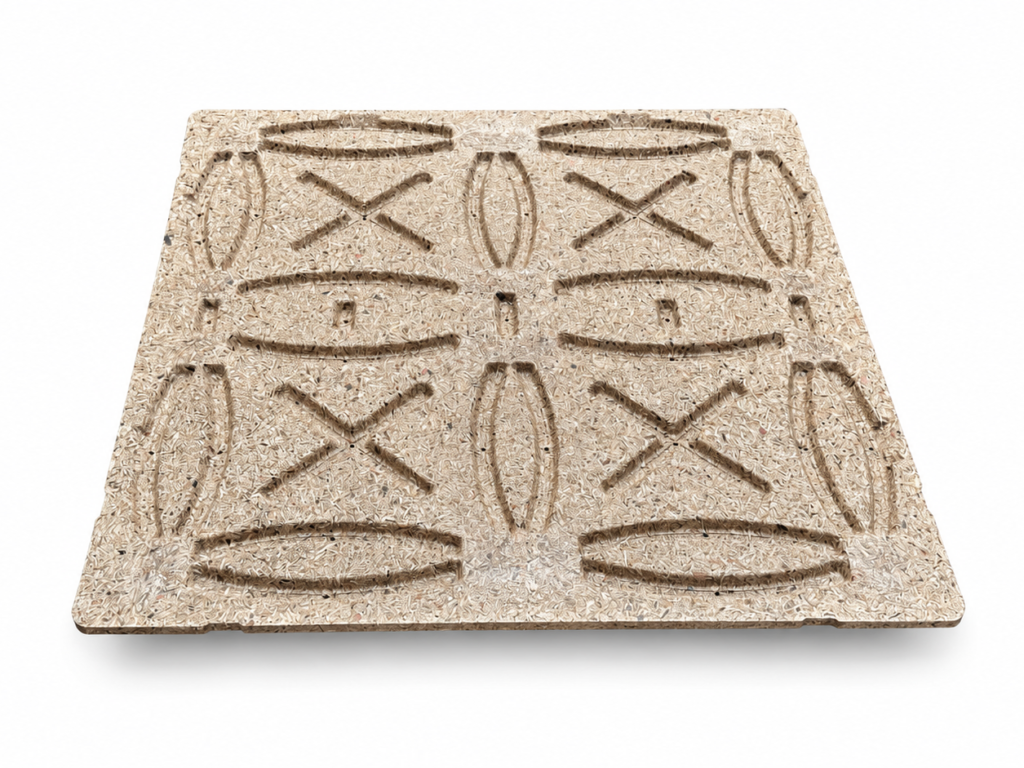
ZK Hydraulic recently completed preliminary production tests using reed as the primary feedstock for molded pallets. Using a standard ZK-1600 hydraulic press and a 1,200 × 1,000 mm nine-foot mold, the team produced three consistent pallets. Reed particles (5–15 mm, incoming moisture around 15%) were mixed with approximately 4% MDI adhesive. The resulting pallets showed smooth glossy surfaces, clean edges, no mold sticking, and dimensions of roughly 1,200 × 1,000 × 135 mm at about 19.7 kg. Preliminary drop and bending tests indicated good toughness. These results add reed to a growing list of evaluated biomasses that already includes hemp stalks, flax, coconut fiber, rice husks, and palm residues.
Why Biomass Flexibility Matters for Presswood Pallet Machines
A presswood pallet machine applies heat and high pressure to bond wood particles or agricultural fibers with a binder, creating a single-piece molded pallet. The process typically uses 4–5% MDI or higher ratios of UF resin, depending on the material and required performance. Because the wood structure is broken down under elevated temperature and pressure, qualifying products are generally classified as processed wood and can qualify for ISPM-15 exemption. This removes the need for separate heat treatment or fumigation certificates that apply to solid-wood packaging.
Market research from Future Market Insights places the molded wood pallets market near USD 2.3 billion in 2026, with a projected path toward roughly USD 4.1 billion by 2036 at about 6.1% CAGR. Nestable designs already capture nearly half the segment because exporters value the ability to stack empties tightly and cut return or storage volume by 60–70%. India is currently the fastest-growing country market. Over 70% of surveyed exporters prefer ISPM-15-exempt options to simplify customs clearance.
At the 140th Canton Fair, buyers arrived with photos of local waste rather than standard specifications. They asked whether sawdust, plywood offcuts, straw, bagasse, or mixed fibers could become pallets. Material preparation—particle size, moisture, adhesive ratio, and mold design—determines whether a line runs profitably. The press supplies force; the mold and upstream preparation decide success. Full turnkey lines that include chipping, drying, mixing, pressing, and temperature control consistently outperform isolated presses in real projects.
Practical Considerations for Operators
- Material testing first: Send representative samples for trials before finalizing equipment. Different feedstocks require adjustments in drying, size reduction, and formulation.
- Mold strategy: Prioritize nestable export formats for the largest demand segment; add rackable or specialized molds only after confirming orders.
- Adhesive and process: MDI typically allows lower addition rates and better moisture resistance than traditional resins. Holding times and temperatures (often around 170 °C in recent trials) must be optimized per material.
- Regulatory edge: Confirm the finished product meets processed-wood criteria under ISPM 15 (see official guidance from the International Plant Protection Convention). Document the process for customers.
- Economics: Local biomass can lower feedstock cost, but collection, transport, and energy use still matter. Automation of feeding and demolding improves consistency and labor efficiency.
ZK Hydraulic and partner capabilities at PalletsBiz continue to support both wood-fiber and complementary plastic pallet molding solutions. Equipment ranges commonly span 800–3,000 tons, with molds engineered for repeated high-cycle use. Recent project deliveries, including large automated lines in Vietnam and complete systems to other regions, illustrate demand for reliable turnkey installations.
Outlook
Agricultural residues that once posed disposal problems are becoming feedstock opportunities. Successful reed trials demonstrate that the technical path exists; commercial viability still depends on local supply chains, consistent formulation, and validated load performance. Manufacturers who combine rigorous material testing, flexible mold portfolios, and complete production lines are best positioned as regulations and ESG requirements tighten.
For operators evaluating biomass presswood pallet production, the starting point remains a controlled trial of the actual available material.
Further reading
- Presswood pallet machine overview: https://presswoodmachine.com/presswood-pallet-machine/
- Production process details: https://palletsbiz.com/the-production-process-of-presswood-pallets/
- Raw material guidance: https://palletsbiz.com/best-raw-materials-for-pressed-pallets-production/
- Official ISPM 15 information: https://www.ippc.int/
- Market outlook reference: Future Market Insights molded wood pallets reports