
Walk into any molded pallet plant running mixed post-consumer feedstock and count what sits on the rack. Most of it will be black. That is not a design decision. It is a confession — black swallows the colour variation that no sorting line managed to remove. It also swallows near-infrared light, and that is where the trouble begins.
Under the EU packaging regulation, a pallet that sorting equipment cannot see is a pallet that grades badly on recyclability. From 1 January 2030, badly is not good enough to place on the European market. The industry has spent five years arguing about recycled content percentages. The colour of the pallet may prove the harder problem.
What recyclability grading actually asks of a pallet
Under Regulation (EU) 2025/40, every packaging item sold in the EU gets a design-for-recycling grade from A to E. Pallets count as transport packaging, so the rule reaches them too. Grade D and E items become unsellable in the EU from 1 January 2030. C is the floor until 2035, B from 2035, and from 2038 only A and B may enter the market. The European Commission’s packaging waste file puts the pressure in context. Europe generated 181 kg of packaging waste per person in 2024. It recycled 42.4% of its plastic packaging.
The test is not a chemistry panel. It is a sorting test. Can an automatic line identify the polymer? Can it pull the item out of the stream and turn it into regrind somebody will buy? Europe’s sorting infrastructure answers with near-infrared spectroscopy, and NIR works by reading reflected light. Conventional furnace carbon black absorbs almost all of it. A black molded pallet arriving at a Dutch or German MRF reads as an unknown object. It gets pulled as contamination, landfilled or burned, and the assessment records that outcome honestly.
Three practical consequences follow, and none of them are theoretical.
The four things a molded recycled pallet carries that a bottle does not
Molded pallets are not simple objects. That is the point of the process — it takes dirty flake and builds structure out of it. The same complexity that makes the process profitable makes the recyclability file awkward.
Start with pigment. Black hides batch variation better than any other colour, at the lowest masterbatch cost. A NIR-detectable black exists, built on special organic pigments rather than carbon black. It costs more per kilo. Most plants skipped it, because until this year nobody asked.
Then mineral fillers. Plants add talc and calcium carbonate to stiffen a soft mixed stream. They also push composite density past 0.97 g/cm³. That is roughly where a polyolefin stops floating and starts sinking in a flotation tank. The RecyClass design-for-recycling guidelines use that figure as a screening point for whether an additive has compromised the recycling route.
Then steel. Rackable pallets often carry pressed-in steel reinforcement. That introduces a metal fraction which has to be declared and removed before grinding. Then the RFID tag, potted into a block cavity. It is a foreign object in a regrind stream, and a label in the wrong place can defeat automated identification.
Every one of those is fixable. What is not fixable is discovering them after the mould is cut.
Why the 2030 date is really a 2027 purchase decision
Here is the part that gets missed in compliance seminars. A steel pallet mould runs 250,000 to 300,000 cycles before it needs rework. Press one pallet a minute across two shifts and a single tool lasts roughly two and a half years. Order a mould in 2027 and its pallets will still be selling in 2030. That is the year the grade becomes a market-access condition.
Colour and filler decisions are baked into the tooling drawing, the dosing recipe, and the customer’s approved sample. Changing them later means new masterbatch qualification, a new sample round, and a fresh recyclability assessment. Plants that treat 2030 as a future problem will be re-engineering a live product line at the worst possible moment.
The money is not only in market access. Article 6 grading also feeds extended producer responsibility fees through eco-modulation. A D-grade pallet pays more per tonne than a B-grade one, year after year. Then there is the recycled-content ladder: 35% post-consumer content for non-contact-sensitive plastic packaging from 2030, rising to 65% by 2040. The specification stops being a technical document at that point. It becomes a cost line.
The paperwork nobody has priced in
Since 12 August 2026, every packaging item placed on the EU market needs a declaration of conformity. Manufacturers self-assess it against the regulation’s annex and back it with a technical file. Single-use packaging files stay on record for five years. Reusable packaging files stay for ten. Pallets are reusable, which means a decade of documentation per model, per material composition.
The heavy-metal limit is the trap. Lead, cadmium, mercury and hexavalent chromium together may not exceed 100 mg/kg. The test applies to homogeneous materials separately: base polymer, masterbatch, ink, adhesive, coating, each on its own. Send a whole pallet to a lab and you get a passing number. That is not a compliant file. It is a number.
There is a legacy wrinkle worth knowing about. A 2009 Commission decision allowed plastic crates and pallets a conditional derogation from the heavy-metal limits. The reasoning was that recycled feedstock made those limits hard to meet. Whether it survives under the new regulation is a question. Ask your supplier to answer it in writing, not in conversation.
What this does to a quotation
Most equipment quotations still lead with tonnage. A buyer asking for 1,600 or 1,800 tonnes gets a press size, a cycle time, and a mould price. Nothing on the sheet says what grade the output will reach in a German sorting plant, because the supplier has never tested for it.
That gap is closing from both ends. Recyclability certification bodies now run pallet-sized trials, and the assessment methodology has moved well past bottles and film. RecyClass alone has passed 500 recyclability tests in support of PPWR readiness. On the machine side, the news this week came from the injection camp — a large-tonnage builder announced a supercritical-foam pallet line aimed at lighter parts. Lighter helps with freight and with resin cost. It does nothing for sortability, which is the number the regulation actually reads.
So put the question in the enquiry. Ask what polymer the finished pallet reads as on a NIR line, at what density, with what inserts. Ask for the answer in the same document as the tonnage.
What to change, in the order that costs least
The first move is pigment. Ask the masterbatch supplier for a NIR-detectable black. Then get a sorting test on the finished pallet, not on a colour chip. If the answer is no, switch to grey or blue. Grey already reads as recycled material in most European buyer conversations, and it sorts properly.
The second is filler discipline. Cap mineral loading so the finished part stays below 0.97 g/cm³. Verify it by measuring a cut section, not by trusting the dosing sheet. Stiffness lost to lower filler loading can come back through rib geometry. After the mould is cut, that costs nothing per pallet.
The third is design for disassembly. Specify steel inserts as removable and document their position. Move RFID cavities off the primary load path, so a tag drills out in ten seconds. Buyers of reusable assets increasingly ask for this, and it takes a line drawing rather than a capital budget.
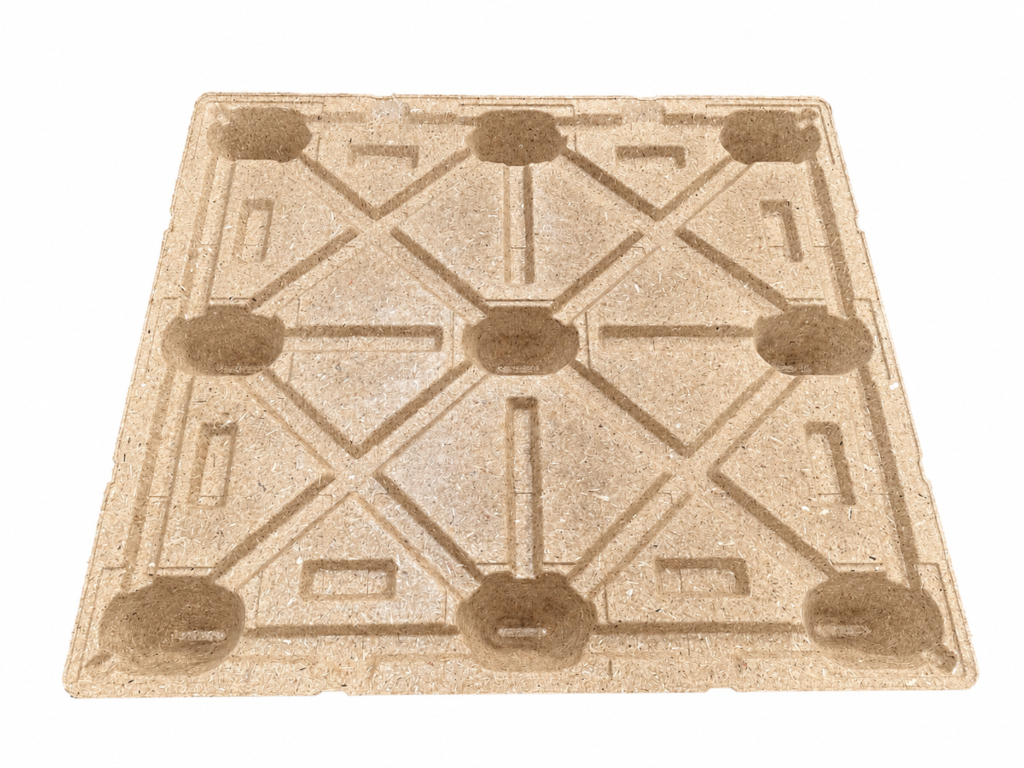
Then test the whole thing. We ran a trial on a 1,300 × 1,100 mm pallet, pressed from 100% mixed recycled plastics with no separation step. The four-core-pulling mould delivered 23 kg finished weight. It carried roughly 2,000 kg dynamic and 6,000 kg static load on a 60-second hold, measured to ISO 8611 methods. That is a load-bearing pallet from feedstock nobody wanted. Whether it is also an A-grade pallet depends on what went into the mix. That is why the plastic pallet molding machine conversation should start with the material declaration, not the tonnage.
Our dual-station press handles colour and formulation changes without a full line stop. That matters more than it sounds once one SKU has to carry a documented composition. Site reports on feedstock switches are collected on the news page. The trial notes behind the numbers above sit alongside them.
The uncomfortable conclusion
Molded pallets have a genuine environmental story. They absorb material that would otherwise be burned, and they replace timber that needs heat treatment. That story will not carry the sector through 2030. The regulator stopped asking what a pallet is made from. It started asking what happens to the pallet afterwards.
The plants still shipping into Europe in 2031 will be the ones paying a slightly higher masterbatch invoice today. Cheaper pigment buys a lower grade and a higher EPR fee. It also buys a product that a customer’s compliance department quietly drops from the approved list. A 23 kg pallet sells for somewhere between €8 and €12. A few cents of pigment is the cheapest insurance in the building.
If you are specifying a line now, send your feedstock sample and target market early. Do it before the mould drawing is fixed. That is a conversation worth having in the first meeting — start it here, and bring the waste, not the wish list.