
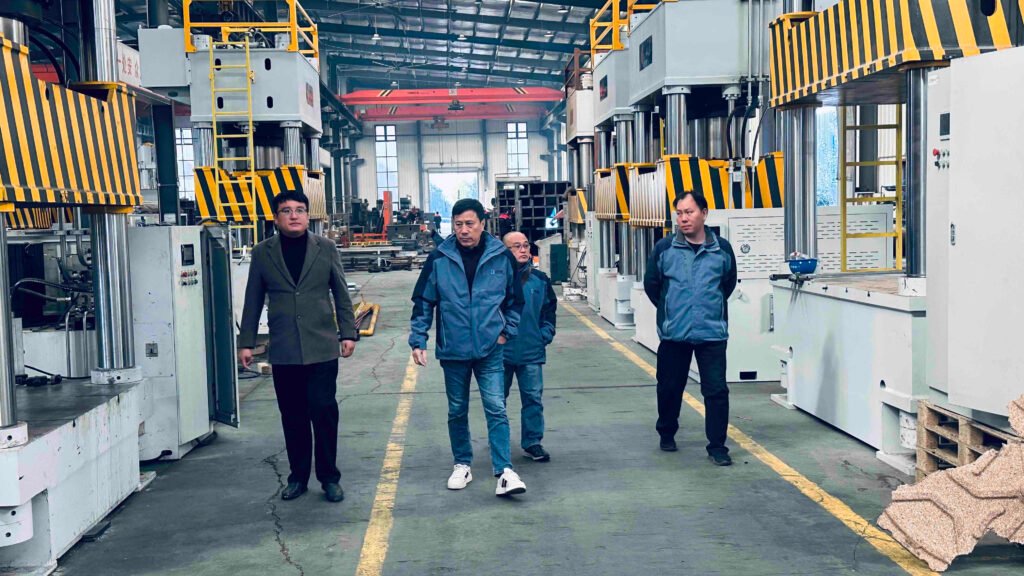
November 10, 2026 — A government-backed business delegation from the Philippines visited ZK Hydraulic on November 9, 2026. The visit covered a full factory tour and working discussions on a long-term cooperation program. It ended with a concrete commitment: an initial purchase of 12 ZK-1600 hydraulic presses, followed by a phased expansion to 128 units as the project scales.
Short on time? Jump to the regional capacity read.
This order at a glance
From Raw Fiber Exports to Value-Added Products
The delegation came with a clear national agenda behind it.
The Philippines holds one of the largest coconut fiber and rice husk reserves in Asia. For years, most of that material has left the country as raw or lightly processed exports. The government now wants to change that, and its plan is to convert waste coir and rice husks into higher-value products at home. Two products sit at the top of the list: molded pallets and coir panels.
This is not a first attempt for the client. They have hands-on experience pressing pallets and panels from coir and rice husks, and they already own two frame-type presses bought from another Chinese manufacturer. Those machines have been a running headache. Under sustained high temperature and pressure, breakdowns happen often. The delegation was blunt about the reasons: the frame structure makes precise mold closing difficult, inaccurate closing damages the molds, and repeated high tonnage slowly deforms the machine frame itself. In their words, a frame press simply is not built for heavy-duty work.
That experience is exactly what brought them to our door.
Why the ZK-1600 Three-Beam, Four-Column Press Won the Day
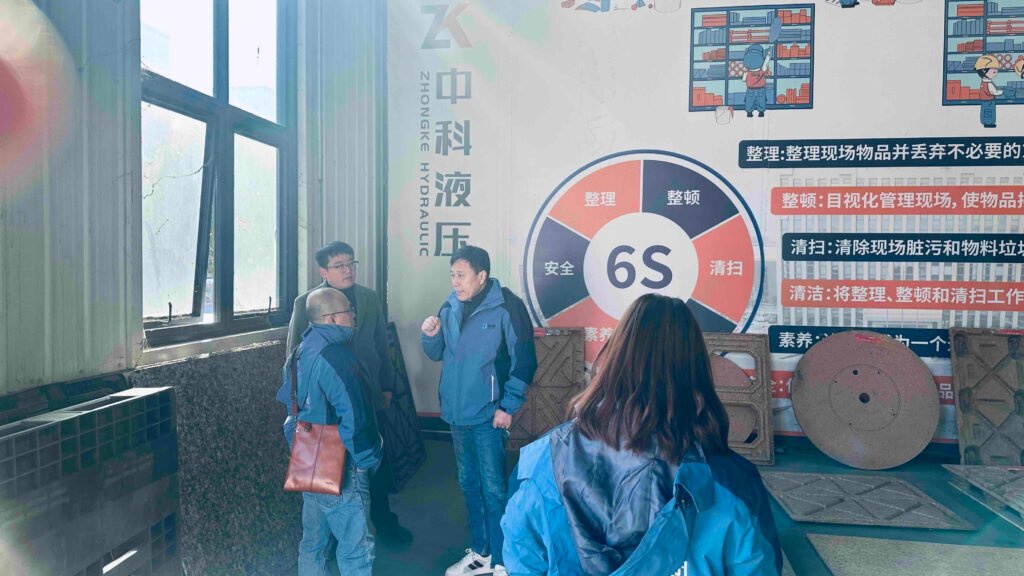
The delegation toured the press assembly workshop, the machining workshop, and the mold manufacturing and assembly lines. They spent extra time at the molding press test area, where the 1600-ton presswood pallet machine runs live pressing cycles.
The ZK-1600 is built on a three-beam, four-column structure. Two columns carry the load on each side, the moving beam stays aligned through every stroke, and the mold closes with tight, repeatable accuracy. Under full tonnage, nothing twists. For a client who has watched frame presses bend and mold cavities get ruined, the difference was easy to see on the floor.
Their evaluation after the tour was straightforward: the three-beam, four-column design is more stable, closes more precisely, and matches their production requirements. The delegation stated they will move forward with in-depth cooperation with ZK Hydraulic.
Manual Lines, Deliberately Chosen
One detail of this order stands out. The client asked for manually operated production lines rather than fully automated ones.
The reason is employment. Each manual line creates steady operator, handling, and finishing jobs for local workers, and the income stays in the community. For a government-backed regional development program, job creation is part of the return on investment, not a cost to eliminate. Our engineers will work with the client on a line configuration that balances economics with local employment — automated where precision demands it, manual where jobs matter most.
We think this is worth saying publicly: automation is not always the only answer. Sometimes the right machine configuration is the one that builds a local workforce along with the product.
What Coir Pallets Can Do
The numbers behind this project justify the scale of the plan. Coir fiber is long, tough, and naturally resilient, and pressed pallets made from it inherit those properties.
A standard 1.2 × 1.0 m coir pallet carries a dynamic load of 2.5 to 3 tons and a static load above 10 tons. That puts it in a class where many buyers previously assumed only timber or plastic could compete — with the added advantages of ISPM 15 exemption, no nails or splinters, and full use of an agricultural waste stream that would otherwise be burned or dumped.
Coir panels round out the product plan. These pressed panels have a flat, uniform surface and a natural fiber color, contain no harmful additives, and suit offices, homes, and shopping centers alike. Interior decoration demand for this material has grown quickly in recent years, and the client intends to serve that market alongside the pallet business.
Beyond Pallets: Drying Towers, Composites, and Steel Silos
The delegation did not stop at pallet equipment. They also took a detailed look at ZK Hydraulic’s drying tower systems, composite material production, and steel silo products, and added all three to their procurement plan.
Drying matters for this project in particular. Coir and rice husks must be dried to a stable moisture content before pressing, so the drying tower is not an optional extra — it is the upstream foundation of the whole line. The steel silos will hold the seasonal harvest of husks and fiber, and the composite material program opens a further product direction for the client’s industrial base.
A Visit That Set the Course
As the delegation departed, their summary of the visit was direct: the factory tour left a deep impression. Product quality is solid. The product range is complete — presses, molds, dryers, silos, composites — which is precisely what a regional development program of this size needs.
The client will push for implementation as soon as possible, and our project team has already started preparing the technical proposal for the first 12 presses. We will share progress as the program moves from agreement to installation.
Trial process
How a customer trials a ZK press before signing anything
Nobody buys a 1,600-ton press off a spec sheet. The Philippine delegation spent a day in the workshops before committing. Here is the sequence every buyer goes through, and who does what at each stage.
-
You
Send the material, not a datasheet
20–30 kg of the actual fiber or flake, from the source you will really be buying from. Add the pallet size you need and the load you have to hit. A sample chosen to look good on the bench tells us nothing about a supply that changes every month.
-
ZK Hydraulic
Match a mould, then press your material
We select the closest existing mould or cut one to your size, then run 3–5 pressing cycles on your material. The number we watch is weight variation between pallets. Stable weight means the blend and the feed are under control.
-
ZK Hydraulic
Test it, don’t describe it
Dynamic and static load to ISO 8611, plus cycle time, density and moisture. Coir pallets in this class come out at 2.5–3 t dynamic and above 10 t static. If your target sits above that, we change the mould or the recipe, and say so before you order.
-
You
Watch the run, in person or on video
A video call during the pressing is enough for most buyers. Visiting is better. The Philippine delegation chose to visit, and spent the extra hours in the press assembly and mould workshops rather than in a meeting room.
-
Both
Fix the line configuration
Tonnage, number of stations, mould count, drying, and manual versus automated. This client chose manual lines on purpose, because the project is meant to create local jobs. Automation is not automatically the right answer, and we will tell you when it is not.
-
ZK Hydraulic
Ship, install, train, then watch the first shift
Equipment ships, our engineer installs and trains your operators, and stays through the first production shift. A press that runs in our workshop and not in yours is a failed delivery, not a successful sale.
Where this process landed: 12 ZK-1600 presses confirmed, phased to 128 units, with the technical proposal for the first batch already in preparation. Start the same sequence by sending your material and target spec.
For inquiries about the ZK-1600 three-beam, four-column press or complete coir and rice husk pallet lines, reach us through the contact page or learn more about ZK Hydraulic. Mold design details for coir and mixed-fiber pallets are also covered in the pallet mold library on our sister site, and the full presswood pallet machine lineup is available on this site.
Regional capacity watch
The Philippine order is the clearest signal yet that molded pallet capacity is moving closer to the waste, not closer to the resin trade. On 9 November a government-backed delegation committed to twelve ZK-1600 hydraulic presses, with a stated path to 128 units. Read that number against freight and duty. A pallet pressed in Luzon from local post-consumer film avoids every import charge that a pellet or a finished pallet would carry.
The same logic is running in Europe. A Polish granulator of eleven years’ standing moved downstream into flake-to-pallet pressing this autumn. EU recyclers lose their non-OECD export window on 21 November, and they need a product to make from what stays home.
Three signals worth tracking each quarter:
- press orders announced in Southeast Asia and the Gulf
- recyclers adding molding lines instead of selling regrind
- quota and duty changes on recyclate, such as the UK SG0094 case
Our trade-policy read on the 65% UK proposal explains what each signal does to pallet economics. The plastic pallet machine range covers the 800 to 3,000-ton configurations those projects are specifying.