
<strong>ZK Hydraulic has successfully completed a series of preliminary production tests using reed as the main raw material for molded pallets. The results demonstrate another potential source of agricultural biomass for presswood pallet manufacturing and further expand the range of materials that can be evaluated for industrial production.</strong>
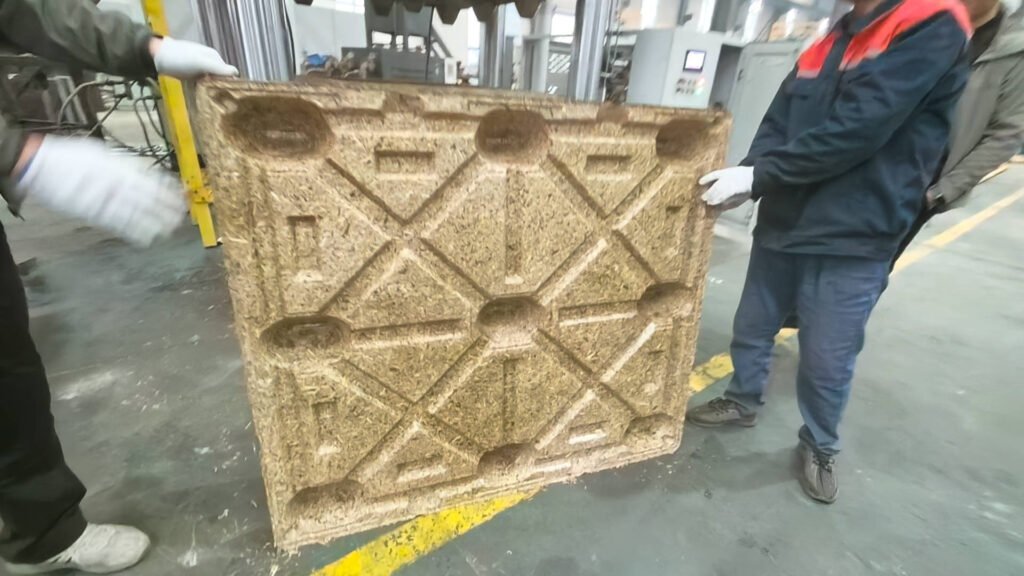
Turning Reeds into Molded Pallets
Reeds grow in wetlands, along riverbanks, around lakes, and in many agricultural areas. They are widely distributed across different regions of the world. In some locations, reed biomass is harvested for land management or other uses. Finding additional applications for this material could create new opportunities for resource utilization.
To evaluate its suitability for pallet production, ZK Hydraulic recently tested reeds supplied by a customer. The objective was to assess the material’s processability, molding behavior, surface quality, and preliminary mechanical performance under controlled production conditions.
The test was conducted using a standard ZK-1600 hydraulic press and a nine-foot pallet mold measuring 1,200 × 1,000 mm. Both the press and the mold were developed and manufactured by ZK Hydraulic.
The results were encouraging. Three pallets were produced using the same operating procedure. All three showed consistent appearance and molding performance, with no observed mold sticking during demolding.
Raw Material Preparation and Adhesive Mixing
The first step was to crush the reeds into particles approximately 5–15 mm in size. The customer’s raw material had a moisture content of about 15%.
This moisture level meant that the material could be evaluated without an additional drying stage in this particular trial. However, the need for drying in commercial production will depend on the incoming moisture content, particle characteristics, adhesive requirements, and final product specifications.
For the mixing stage, the team weighed 57.6 kg of crushed reed material and added 2.4 kg of MDI adhesive. The adhesive was supplied by WANHUA, a Chinese chemical manufacturer.
The reed particles and adhesive were mixed for approximately 40 seconds. The resulting mixture was then removed from the mixer and prepared for molding.
The adhesive represented approximately 4% of the total mixed material by weight. This ratio was used for the trial and should not be treated as a universal formulation for all reed varieties or operating conditions.
For more information about adhesive selection and formulation, see our guides to MDI and other adhesives for presswood pallet production and glue for molded pallet manufacturing.
Molding Process and Test Parameters
Before molding, the operators manually sprayed a release agent onto the mold surface. They then weighed out 20 kg of the prepared mixture and distributed it evenly inside the mold.
Manual feeding was used because this was a material feasibility test rather than a fully automated production run. In commercial applications, feeding and material distribution can be evaluated for automation according to the customer’s production capacity and product requirements.
The test used the following operating parameters:
| Parameter | Test condition |
|---|---|
| Raw material | Crushed reeds |
| Particle size | 5–15 mm |
| Incoming moisture content | Approximately 15% |
| Total mixing batch | 60 kg |
| Reed material | 57.6 kg |
| MDI adhesive | 2.4 kg |
| Material used per pallet | 20 kg |
| Mold type | Nine-foot pallet mold |
| Pallet dimensions | 1,200 × 1,000 × 135 mm |
| Mold temperature | 170°C |
| Press working pressure | 23 MPa |
| Holding time | 120 seconds |
| Hydraulic press | ZK-1600 |
The production cycle consisted of the following operations:
| Operation | Time |
|---|---|
| Manual material distribution | 50 seconds |
| Rapid mold closing | 4 seconds |
| Slow mold closing | 20 seconds |
| Pressure holding | 120 seconds |
| Mold opening and return | 10 seconds |
| Release-agent application | 22 seconds |
| Total recorded cycle time | 226 seconds |
These figures describe the specific trial. Actual production capacity will depend on material preparation, feeding arrangements, mold design, heating conditions, cooling requirements, automation, and other operating factors.
The test also provides a useful reference point for customers evaluating a presswood pallet production process.
Three Pallets, Consistent Results
The first pallet was removed from the mold successfully. No mold sticking was observed.
The finished pallet had a smooth, glossy surface, clean edges, and no obvious excess material requiring deburring. Its measured dimensions were 1,200 × 1,000 × 135 mm, and its weight was 19.7 kg.
The second and third pallets were produced using the same procedure. Their appearance and molding behavior were consistent with those of the first pallet.
The team then conducted preliminary drop and bending tests on all three samples. The pallets showed good toughness and encouraging load-bearing behavior during these initial evaluations. Their observed performance was broadly comparable to that of pallets made from conventional wood particles under the conditions tested.
These results support further development of reed-based molded pallets. However, the initial tests do not establish a certified load rating or long-term durability. More comprehensive testing will be needed to quantify static and dynamic load capacity, bending resistance, repeated-impact performance, moisture resistance, and dimensional stability.
Reed Is the Latest Addition to a Growing Range of Biomass Materials
Reed is not the first alternative raw material evaluated by ZK Hydraulic.
Previous material trials have included hemp stalks supplied from the United States, flax stalks from France, coconut fiber from Thailand, rice husks from Vietnam, oil palm residues from Malaysia, date palm residues from the Middle East, and chili and cotton stalks from China.
These trials reflect a broader opportunity for molded pallet manufacturing. Agricultural residues vary from country to country, but many regions generate substantial quantities of plant-based by-products that may be suitable for engineered products.
The key is not simply whether a material can be pressed into a pallet. Its commercial suitability also depends on particle size, moisture content, fiber structure, adhesive compatibility, mold temperature, pressing conditions, finished weight, mechanical performance, and production cost.
For businesses exploring local feedstocks, our articles on raw materials for pressed pallet production and rice husk presswood pallets provide further background.
Why Raw Material Flexibility Matters
Raw material availability is an important factor when establishing a pallet manufacturing operation. A plant that can use suitable locally available biomass may reduce dependence on a single feedstock and improve its flexibility in sourcing materials.
This does not mean every agricultural residue can be used directly or economically. Different feedstocks require individual evaluation, and some may need additional drying, size reduction, blending, or formulation adjustments.
For this reason, material trials are an essential step before finalizing equipment specifications and production costs.
As a China presswood pallet machine manufacturer, ZK Hydraulic develops hydraulic presses and molds for molded pallet applications and evaluates material-specific production conditions. The objective is to help customers determine which locally available resources can be converted into consistent, commercially viable pallets.
For companies considering equipment options, a presswood pallet molding machine can be assessed alongside the raw material preparation system, adhesive mixing equipment, mold configuration, and production automation. The appropriate setup depends on the selected feedstock and the required pallet specifications.
Molded Pallets and the Changing Requirements of Export Packaging
Export packaging requirements continue to place greater emphasis on material efficiency, product protection, and international phytosanitary compliance.
Molded presswood pallets made from processed wood particles and suitable binders can offer an advantage in international shipping because qualifying processed-wood packaging may be exempt from the conventional ISPM 15 treatment requirements that apply to regulated solid-wood packaging. The exemption depends on the material and the applicable rules, so exporters should confirm the classification of their specific packaging.
The International Plant Protection Convention provides official information on ISPM 15 and international wood packaging regulations. This distinction is particularly relevant to companies comparing molded presswood pallets with conventional solid-wood pallets.
Another important consideration is feedstock cost. Where suitable agricultural residues are locally available at competitive prices, they may provide an alternative source of raw material. The final economics will depend on collection, transport, preparation, adhesive consumption, energy use, labor, and product performance.
For a broader comparison of pallet materials, see presswood pallets versus plastic pallets.
It is also important to distinguish presswood technology from plastic pallet manufacturing. A Presswood pallet molding machine processes suitable plant-based particles with an appropriate binder. A Plastic Pallet molding machine uses a different material system and molding process, particularly when processing recycled PP or PE. Both technologies can support resource-efficient pallet production, but their raw materials, equipment configurations, and processing requirements are not interchangeable.
What Comes Next?
The successful reed trial is a promising step, but industrial adoption requires more than producing a few acceptable samples.
Further work should focus on repeatable production, optimized adhesive consumption, moisture tolerance, cycle-time improvement, mold release, finished-product consistency, and standardized mechanical testing. Longer production runs will also help determine whether reed can be processed reliably at commercial scale.
For potential customers, the practical starting point is to assess the local feedstock, test its properties, establish a suitable formulation, and validate the finished pallet against the intended application.
ZK Hydraulic will continue evaluating alternative biomass materials and developing molding solutions for different feedstocks. The goal is to help manufacturers make better use of local resources and build pallet production systems around technically suitable, economically viable raw materials.
Reed has now joined the growing list of materials successfully evaluated in ZK Hydraulic’s molded pallet trials. This result reinforces an important principle: the future of molded pallet manufacturing may depend not only on better machines, but also on finding more effective uses for the resources available in each region.
About ZK Hydraulic
ZK Hydraulic specializes in hydraulic presses, molds, and equipment solutions for molded pallet manufacturing. Through material testing and process development, the company works with customers to evaluate agricultural residues and other suitable feedstocks for pallet production.
For technical discussions or a raw material feasibility assessment, visit PresswoodMachine.com or PalletsBiz.com.