
Search for the racking load of a molded wood pallet and you will find three different answers for what is nominally the same product: 1,000 kg, 544 kg, and “not rated for open-beam rack storage.”
That is not a rounding difference. It is the difference between a pallet that goes into a 12-metre-high racking system and one that must stay on the floor. And the reason all three numbers can coexist online is simple: most of them were never measured. One came from a supplier’s marketing sheet, one was converted from an American pallet-weight blog that copied another blog, and one was written by someone who understood the geometry better than the rest.
If you are specifying molded pallets for a warehouse rather than a one-way export container, this distinction decides whether your project works. So let’s do it properly.
The definition, without the hedging
Racking load is the maximum uniformly distributed load a pallet can carry when it is supported only along two opposite edges — the rack beams — with nothing underneath the middle of the deck.
It is almost always the lowest of a pallet’s three ratings, and it is the only one that is measured against time rather than against a single event. Under ISO 8611-1:2025, the racking test places the loaded pallet across two supports and holds it. Mid-span deflection has to stay within roughly 2% of the pallet’s length — about 24 mm on a 1200 mm pallet — across a 24-hour hold, with no permanent set that would impair handling afterwards.
Read that again, because it is where most spec sheets quietly fall apart. A static load rating is a snapshot: put weight on a pallet sitting on concrete, see if it breaks. A racking rating is a creep test. The pallet is asked to hold a bending load for a full day, and wood-composite and plastic both move under sustained load in ways they never do under a five-second proof load.
Why the three numbers are so far apart
Static, dynamic and racking ratings differ because the support conditions differ, and the geometry explains almost all of it.
On the floor, a molded pallet rests on its entire base — nine legs, or three runners, or a full footprint. Load travels down through short, stiff columns in pure compression. Composite wood is very good at this. Static ratings in the 4,000–7,500 lb range (1,800–3,400 kg) are normal and honest.
On a forklift, the pallet is carried on two or three forks that may not align perfectly with its structure, and it is being accelerated, braked and bounced. Dynamic ratings drop to roughly 1,500–2,500 lb.
In a rack, the pallet becomes a beam. Two edges are supported, the span in between is not. Every kilogram in the middle of the deck is now producing bending moment in a deck that was designed as a plate, and the failure mode changes from crushing to sagging — a slow, silent, cumulative sag that nobody notices until the pallet no longer sits flat on the beam, or the unit load leans into the aisle.
That is the mechanism behind the third number you find online. American pallet-weight guides routinely list presswood racking at 800–1,200 lb (360–545 kg) while listing the same pallet’s dynamic rating at 1,500 lb. Some simply write “not rated.” They are describing the pallet most of the world actually buys: a nestable nine-leg one-way export pallet, 25–30 kg, priced at roughly USD 10–11 ex-works, sold by the container load.
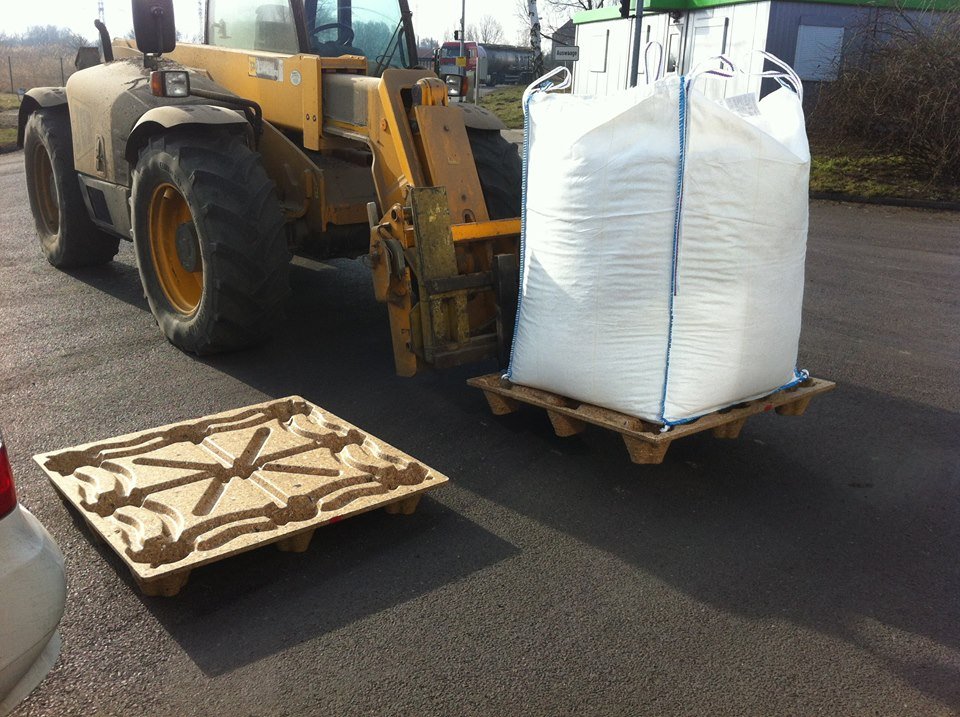
A nestable one-way pallet has no business in a rack. The tapered legs that let you stack 50 empties into a 2.2-metre column are the same feature that leaves the deck unsupported between beams. This is the single most common specification error we see: a plant standardises on cheap nestable pallets for export, discovers they save money, then starts using the same pallet for internal high-bay storage because it is the pallet that is already there.
So what makes a molded pallet rackable?
Not tonnage. This is where buyers get sold the wrong thing, and where our own industry deserves some criticism — including us, when we have quoted racking figures without saying which mold family produced them.
The press decides density and cycle time. The mold decides whether the pallet can span. Four things change the racking number:
Bottom-deck structure. A rackable molded pallet carries a reinforced bottom deck — deeper ribs running across the beam direction, or a moulded-in runner pattern that turns the underside into a shallow box beam. Adding 6–8 mm of rib depth at the bottom of a 145 mm pallet costs very little material and can move the racking rating by a factor of two. It also costs you nest ratio, which is the trade nobody mentions: rackable pallets stack worse.
Density. At 900 kg/m³ a molded pallet is denser than most hardwoods. Below about 850 kg/m³ you are buying voids, and voids are where a deck fails first. Density comes from fiber preparation, glue ratio, tonnage and mold temperature together — which is why a complete presswood pallet line matters more than the press alone.
Deck thickness and span ratio. A 1200×800 pallet spanning 1000 mm of beam spacing is a different structure from a 1200×1000 spanning 1150 mm. Ratings are only valid for the span they were tested at, and almost no supplier publishes the span.
Beam contact position. Put the beams under the pallet’s outer runners and you are loading the stiffest part of the deck. Put them 30 mm inboard and you are loading a panel. Warehouse engineers rarely check this; pallet suppliers rarely ask.
Future Market Insights makes the point bluntly in its October 2026 molded wood pallet report: unsupported open-beam high-bay racking still requires bottom-deck reinforcement, and the segment that actually buys this category is medium-duty (751–1,500 kg) export freight, not warehouse storage. The market is 2.3 billion USD in 2026 heading to 4.2 billion by 2036 at a 6.2% CAGR — and it is being built on pallets that were never designed to be racked.
Why this is about to matter more, not less
Three things are converging.
Warehouses are getting taller. Automated storage and retrieval systems now plan at 25–40 m of clear height, with shuttle and crane systems designed around pallet tolerances measured in millimetres. At that height the pallet is not a consumable — it is a component of a machine, and a deck that sags 8 mm is a fault the crane cannot see. Racking designers already work to beam deflection limits around L/180 and out-of-plumb tolerances of roughly half an inch per 10 feet.
Overload is the second leading cause of rack failure after forklift impact, and it never announces itself. A pallet rated honestly at 800 kg and used at 800 kg is safe. A pallet rated optimistically at 1,200 kg and used at 1,100 kg is a slow failure that surfaces as a bent beam six months later, when nobody remembers which supplier’s number was wrong.
The pallet itself is getting cheaper per unit — 255–275 million engineered pressed wood pallets shipped in 2026, average selling price USD 10.1–10.9 according to Data Insights Reports — while the cost of getting the specification wrong keeps climbing.
What to actually ask for
If you are buying molded pallets for anything other than floor storage or a one-way container, ask for these five things in writing. A supplier who cannot produce them is guessing.
- The racking rating, and the span it was tested at. “1,000 kg” without a beam spacing is not data. Ask for the test span in millimetres and the beam contact position.
- The test standard and its edition. ISO 8611-1 was revised in 2025; the edition before it was itself a revision. A report citing a superseded edition is not disqualifying, but a supplier who does not know which edition they tested to is telling you something.
- The 24-hour deflection figure in millimetres. Not a pass/fail stamp — the number. If it is missing, the report is a proof test, not a racking test.
- Whether the rating is for the mold you are ordering. Nestable and rackable molds from the same supplier carry different numbers, and quotes often blend them.
- The test conditions. Composite wood loses stiffness as moisture content rises. A rating taken at 20°C and 50% RH is optimistic for an unheated warehouse in a monsoon climate, and wildly optimistic for a cold store where condensation forms on every inbound pallet.
We publish static and dynamic ratings for our standard molds and discuss racking case by case, because it genuinely depends on the span and the beam layout your facility uses. If a supplier gives you a single racking number for the whole catalogue, treat it as a starting point for a conversation, not a specification.
When a molded pallet is the wrong answer
There is a version of this article that ends with “molded pallets work everywhere.” They don’t.
If your operation is 90% open-beam racking at 1,200 kg unit loads, a reinforced plastic pallet or a block pallet with a proper bottom deck is the mature answer, and a recycled plastic pallet line or conventional supply will serve you better than forcing a wood-composite deck into a duty it was not designed for. Molded pallets win on one-way export, on floor and stacking storage, on hygiene-sensitive food and pharma flows, on return logistics where nest ratio cuts empty freight, and on any lane where the ISPM-15 exemption removes a treatment step. They win on racking only when the pallet was designed for it — and that is a mold decision made at the quotation stage, not a promise made at delivery.
For the baseline numbers across the whole category, our load capacity reference is a reasonable starting point. Just read it the way you should read every spec sheet in this industry: asking, at every line, tested how, at what span, for how long.
The bottom line
Racking load is not a marketing number. It is a creep measurement taken over 24 hours on two beams, and it decides whether your molded pallets can leave the floor. The industry’s published figures range from 360 kg to 1,000 kg for the same nominal product because most of them were never tested — and because the two families being compared, nestable one-way and rackable reinforced, are not the same at all.
Buy the mold for the duty. Ask for the span, the deflection, the standard edition and the humidity. Everything else is a proof test dressed up as a promise.