
Coconut is one of the most widely used agricultural products in tropical regions. It provides food, coconut water, oil, shells, fiber, and many other useful materials.
But there is another valuable part of the coconut that is often treated as agricultural waste: the coconut husk.
Coconut husk contains a large amount of natural coir fiber. With proper processing, this fiber can be used as a raw material for making molded pallets.
Coconut fiber molded pallets can turn an agricultural by-product into a useful industrial product. They can also reduce dependence on conventional wood materials.
This article explains the structure of a coconut, which part can be used for pallet production, and the complete manufacturing process from coconut husk to finished molded pallet.
1. Understanding the Structure of a Coconut
Before discussing the manufacturing process, it is important to understand the basic structure of a coconut.
A mature coconut generally consists of several main parts:
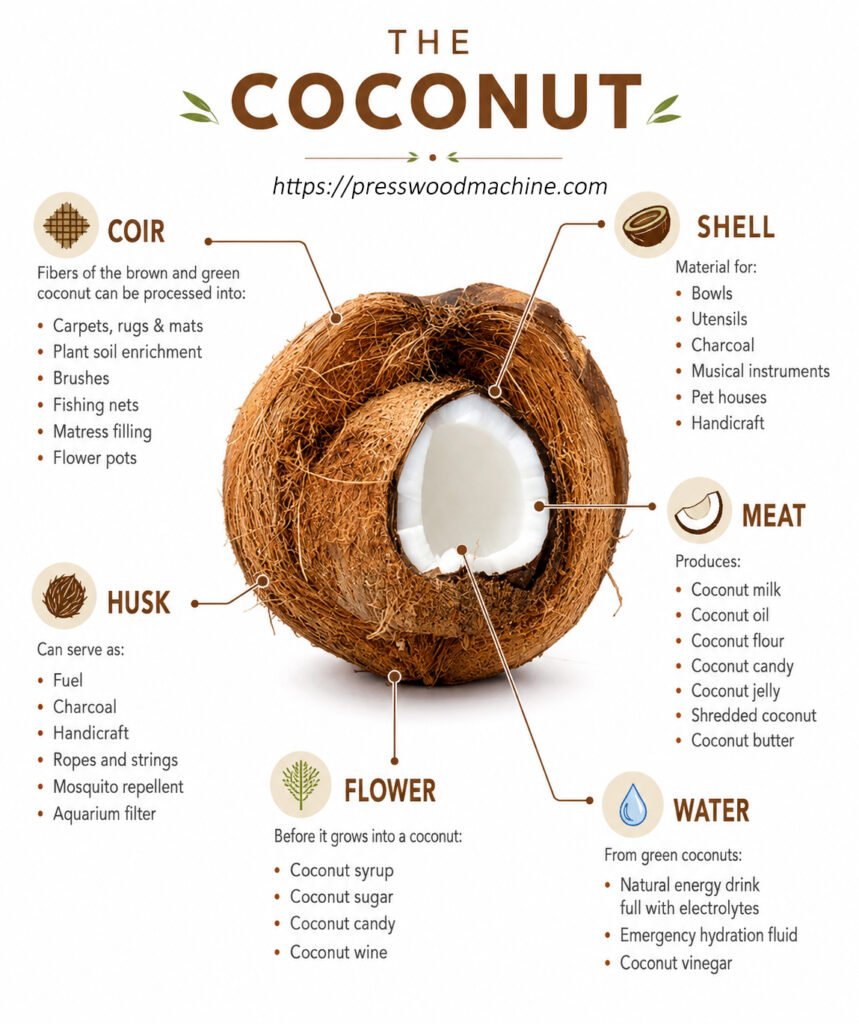
- Exocarp – the outer skin
- Mesocarp – the thick fibrous husk
- Endocarp – the hard inner shell
- Coconut meat – the edible kernel
- Coconut water – the liquid inside the coconut
The mesocarp, commonly called the coconut husk, is the most important part for producing coconut fiber molded pallets.
The coconut husk is especially interesting because it contains both coir fiber and coir pith.
According to the Food and Agriculture Organization of the United Nations (FAO), coconut husk is composed of approximately 70% pith and 30% fiber on a dry-weight basis. FAO also notes that coconut husk can be used as a raw material for many products.
This makes coconut husk a potentially valuable source of industrial fiber.
Which Part of the Coconut Is Used for Pallets?
For molded pallet production, the main target material is:
Coconut husk → Coir fiber
The hard coconut shell is not the main raw material for this process.
The coconut meat and coconut water are also not used for producing the pallet.
The objective is to recover as much useful fiber as possible from the coconut husk.
2. Why Use Coconut Fiber to Make Molded Pallets?
Coconut fiber has several characteristics that make it interesting for molded products.
Coir is a natural lignocellulosic fiber. FAO data show that brown coir contains a relatively high lignin content compared with many other plant fibers. Coir also has good resistance to water compared with some other natural fibers.
The use of coconut husk can provide several potential benefits:
- Agricultural waste utilization
- Reduced dependence on virgin wood
- Local raw material availability in coconut-producing regions
- Potentially lower raw material costs
- Renewable fiber source
- Suitable for molded fiber products
- Opportunity to create additional value from agricultural residues
This concept is similar to using other agricultural residues for molded pallets.
For example, rice husk can also be processed into molded pallets. You can read more about this material in our article:
Can Rice Husk Be Used to Make Molded Pallets?
The important point is that not every agricultural residue behaves in the same way.
The raw material must be properly processed before it enters the pallet molding process.
3. The Complete Coconut Fiber Pallet Manufacturing Process
The basic production process is:
Coconut Husk → Size Reduction → Fiber Cutting → Screening → Drying → Glue Mixing → Hot Press Molding → Finished Pallet
The main machines used in the process are:
- Coconut husk chipper or shredder
- Fiber cutting machine
- Rotary drum screen
- Rotary drum dryer
- Glue and fiber mixing machine
- Hydraulic molded pallet press
- Pallet mold
Let’s look at each step in detail.
4. Step 1: Prepare the Coconut Husk
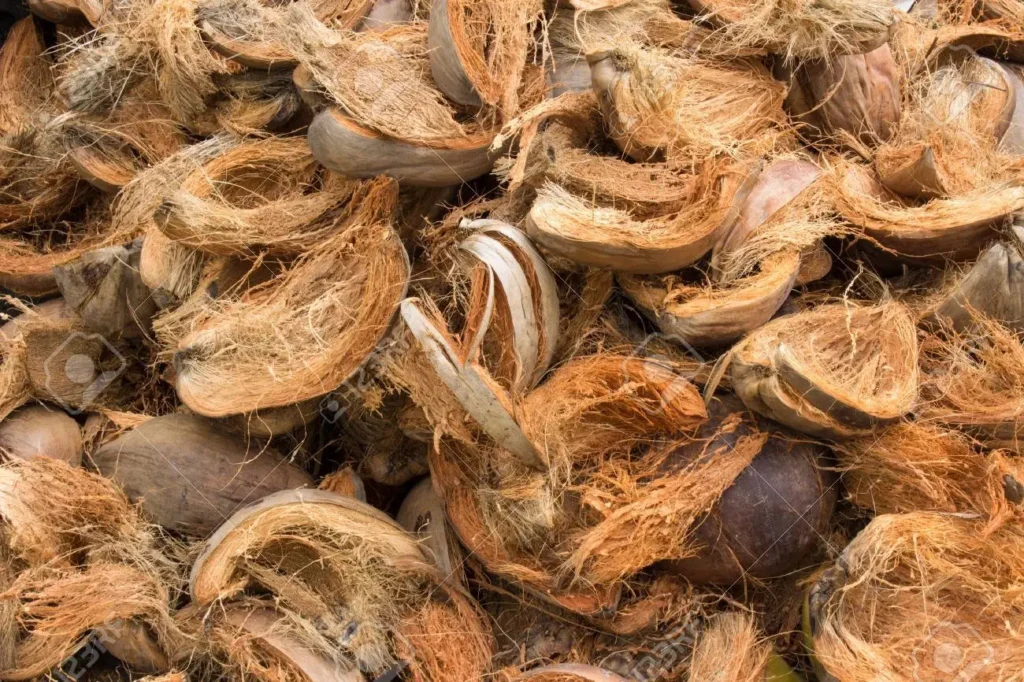
The first step is to prepare the coconut husk.
Fresh or dried coconut husk is normally too large and irregular to be used directly in the pallet molding process.
A chipper or shredder is used to reduce the size of the husk.
The target size can be around: 50 mm × 50 mm
The exact size can be adjusted according to the characteristics of the raw material and the next processing machine.
The purpose of this step is not to produce the final fiber size.
Instead, it makes the husk easier to process in the next stage.
Smaller pieces are easier to separate, cut, dry, and screen.
Recommended Equipment
- Shredder Machine
- Wood chipper
The correct machine depends on the moisture content, hardness, fiber length, and daily processing capacity.
5. Step 2: Cut the Coconut Fiber to the Correct Length
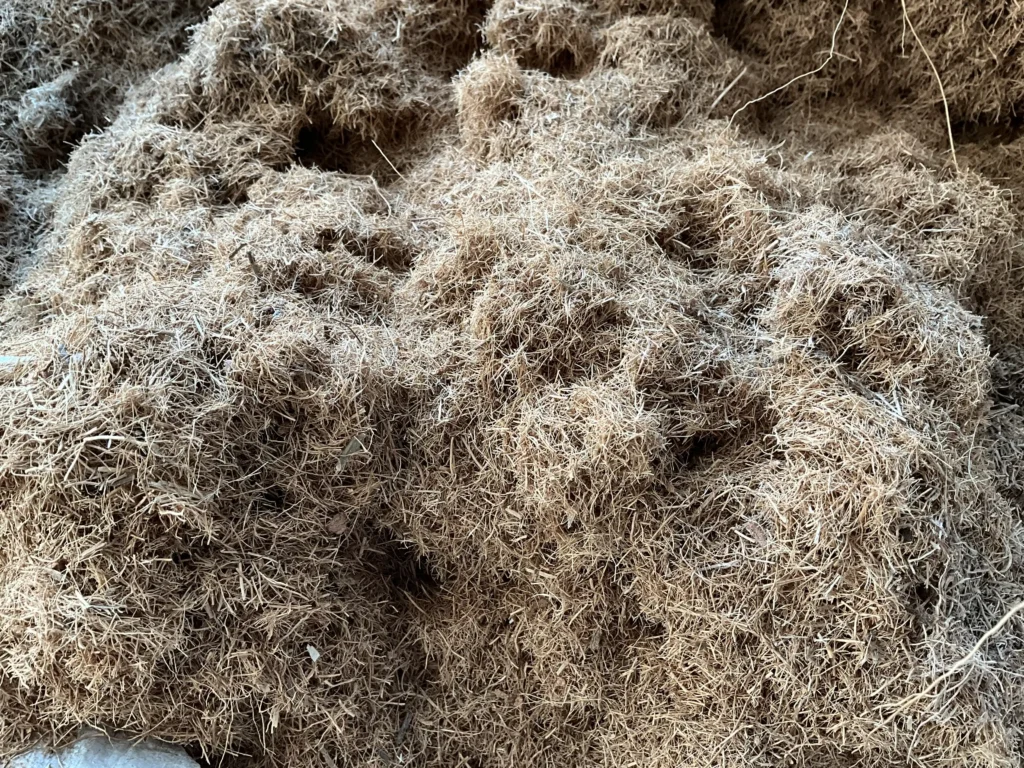
After the coconut husk has been reduced in size, the next step is to process the fiber.
A fiber cutting machine can be used to reduce the coir fiber to a controlled length.
For molded pallet production, a fiber length of approximately: 5–15 mm is a practical starting range.
Why is fiber length important?
If the fibers are too long, they can become difficult to distribute evenly inside the mold.
Long fibers may also create fiber entanglement.
This can cause:
- Uneven material distribution
- Surface defects
- Uneven pallet thickness
- Difficult mold filling
- Inconsistent pallet density
If the fibers are too short, the reinforcing effect of the fiber may be reduced. Therefore, a controlled fiber length is important. A 5–15 mm fiber size can provide a good balance between material distribution, surface quality, and mechanical performance.
However, the ideal fiber size should always be confirmed through actual production trials.
6. Step 3: Remove Excess Coconut Pith with a Rotary Screen
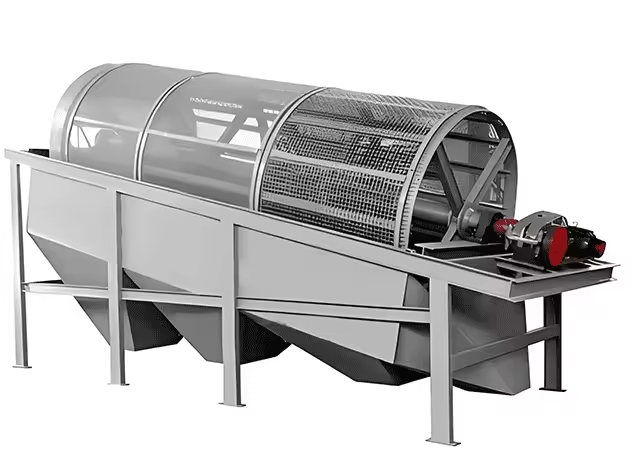
Coconut husk contains both fiber and pith. The fiber is the main structural material we want to keep. The pith is a much finer material. A large amount of pith can increase the amount of material that needs to be dried without providing the same reinforcing effect as longer coir fibers. For this reason, a rotary drum screen can be installed before the drying process.
The screening process separates:
Coir fiber → Keep
Excess coir pith → Remove or partially recycle
The objective is not necessarily to remove all pith. A certain amount of fine material can remain in the mixture. The goal is to remove excessive pith while maintaining good material utilization. This also has an important energy-saving benefit. The less unnecessary fine material that enters the dryer, the less energy may be required to remove its moisture. This is particularly important for large-scale coconut fiber pallet production.
7. Step 4: Dry the Coconut Fiber
After screening, the coconut fiber enters the drying process. A rotary drum dryer can be used for continuous industrial drying. Moisture control is one of the most important parts of molded pallet production. For coconut fiber molded pallets, the target moisture content can be controlled at approximately: 13%–17%
The actual optimum value depends on:
- Fiber characteristics
- Adhesive type
- Adhesive dosage
- Mold temperature
- Pressing pressure
- Pressing time
- Final pallet density
- Production conditions
The purpose of drying is not simply to make the material as dry as possible. The objective is to reach a moisture level that works well with the selected adhesive and molding process. Over-drying can increase energy consumption. Excessive moisture can affect adhesive performance and molding quality. Therefore, moisture control should be treated as a key process parameter.
8. Step 5: Mix Coconut Fiber with MDI Adhesive
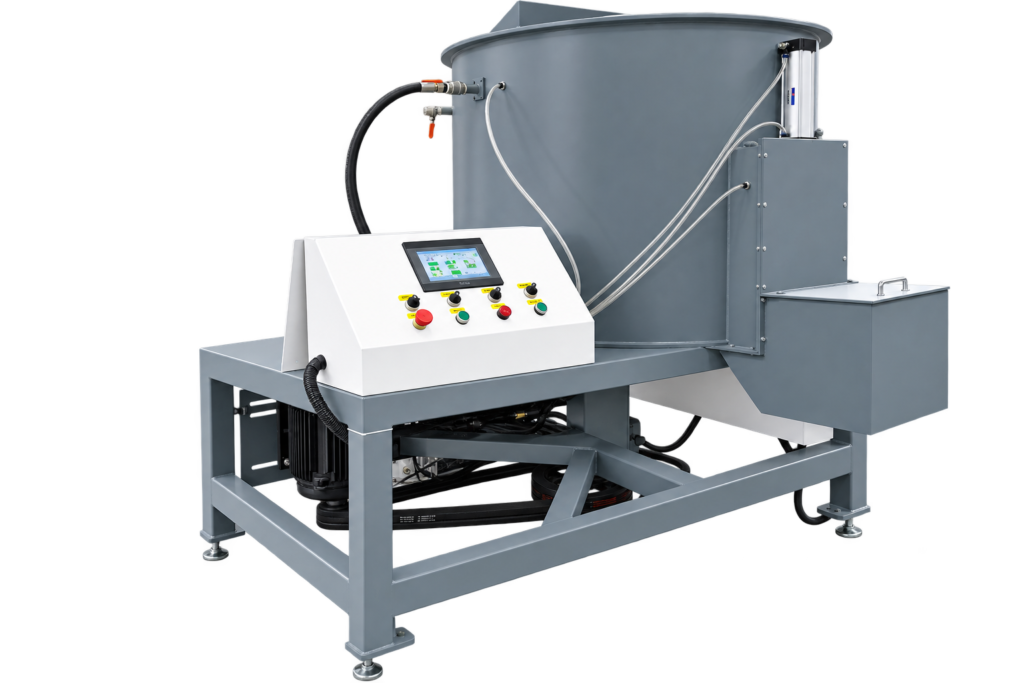
After drying, the prepared coconut fiber is mixed with adhesive. For this application, MDI adhesive is a recommended option. A starting formulation can be: 96% coconut fiber + 4% MDI adhesive
The exact adhesive dosage should be confirmed through testing because different coconut husks can have different:
- Moisture contents
- Fiber structures
- Pith contents
- Fiber lengths
- Bulk densities
- Surface characteristics
MDI is widely used in engineered wood and fiber-based molded products because it can provide strong bonding. Proper mixing is critical. The adhesive should be distributed evenly across the fiber. Poor mixing can create areas with too little adhesive and areas with excessive adhesive. This can lead to inconsistent strength and surface quality. A dedicated fiber and glue mixing machine is therefore recommended.
For more information about MDI and molded pallet production, see:
How to Prevent Mold Adhesion When Using MDI Adhesive in Presswood Pallet Production
9. Step 6: Form the Coconut Fiber Molded Pallet
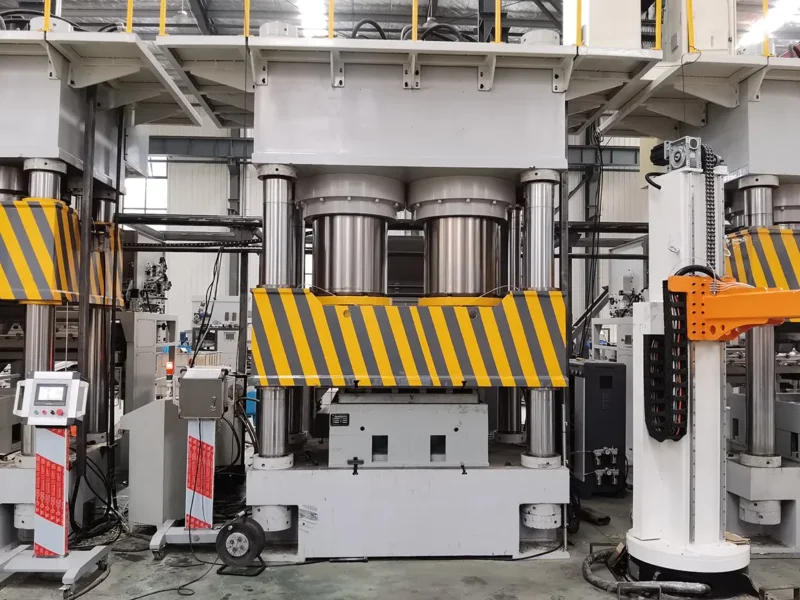
The final major step is hot pressing. The prepared coconut fiber and adhesive mixture is evenly distributed into the pallet mold. The mold is then installed on a hydraulic molded pallet press.
For example, ZK Hydraulic’s ZK-1600 hydraulic press is designed for molded pallet production. The machine provides high pressing force to compact the fiber material inside the mold. A high-pressure molding process can produce a dense and uniform pallet structure. For a suitable material formulation and production condition, the target density can reach approximately: 950–980 kg/m³
Higher density generally helps improve:
- Load-bearing capacity
- Structural stability
- Water resistance
- Durability
- Surface quality
However, pallet performance does not depend on density alone.
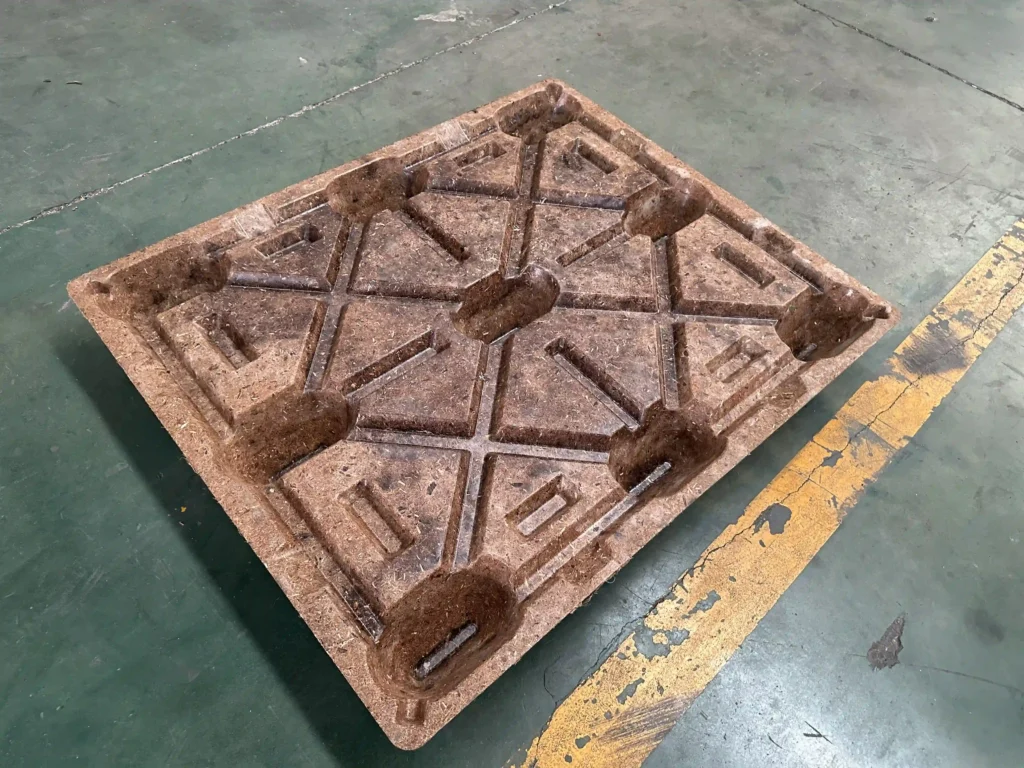
The final performance is also affected by:
- Raw material type
- Fiber length
- Moisture content
- Adhesive type
- Adhesive dosage
- Mold design
- Pressing pressure
- Mold temperature
- Pressing time
- Cooling conditions
This is why laboratory testing and production trials are important before commercial production. You can also learn more about the relationship between pressure and molded pallet quality here:
How Pressure Affects the Quality of Molded Pallets
10. ZK-1600 Hydraulic Press for Coconut Fiber Pallets
The ZK-1600 is a hydraulic press developed for molded pallet production. The machine provides sufficient pressing force to compact agricultural fibers and wood-based materials into a high-density pallet. For coconut fiber applications, the machine can be configured according to the pallet size, mold design, raw material, and production requirements. The potential production capacity can reach approximately: Up to 20 pallets per hour
Actual output depends on:
- Pallet dimensions
- Pallet weight
- Raw material
- Moisture content
- Adhesive formulation
- Mold design
- Heating temperature
- Pressing cycle
- Operator and production conditions
The ZK-1600 can therefore be considered for customers who want to establish a commercial coconut fiber molded pallet production line.
11. Complete Coconut Fiber Pallet Production Line
A typical production line can be arranged as follows:
Coconut Husk
↓
Husk Chipper / Shredder
↓
Fiber Cutting Machine
↓
Rotary Drum Screen
↓
Rotary Drum Dryer
↓
Glue Mixing Machine
↓
Material Feeding System
↓
ZK-1600 Hydraulic Press
↓
Molded Coconut Fiber Pallet
The actual equipment configuration can be adjusted according to the customer’s raw material and required production capacity.
For example, a factory with a large supply of coconut husk may require automatic feeding, larger drying equipment, dust collection, and continuous material handling systems.
12. What Kind of Coconut Husk Is Suitable?
Not all coconut husk is exactly the same.
The characteristics can vary depending on:
- Coconut variety
- Coconut maturity
- Harvesting method
- Storage conditions
- Moisture content
- Fiber content
- Pith content
- Fiber length
Before designing a complete production line, we recommend testing the actual coconut husk available at the customer’s location.
The test should include:
- Moisture content
- Fiber content
- Pith content
- Bulk density
- Fiber length
- Adhesive consumption
- Moldability
- Finished pallet density
- Static load capacity
- Dynamic load capacity
- Water resistance
This approach reduces production risk and helps determine the correct equipment configuration.
13. Coconut Fiber vs. Other Raw Materials
Coconut fiber is only one of many agricultural residues that can be used for molded pallet production.
Other possible materials include:
- Wood chips
- Sawdust
- Rice husk
- Straw
- Bamboo fiber
- Hemp hurd
- Palm residues
- Other agricultural fibers
Each material has different physical characteristics. For example, rice husk contains a high percentage of silica, while coconut fiber has a different fiber structure and relatively high lignin content. This means the same formula cannot always be used for different raw materials. The production process must be adjusted according to the material.
You can read more about different molded pallet materials in:
Step-by-Step Wood Chips Pallet Block Manufacturing Process
and:
Molded Pallets Styles and Applications
14. Why Coconut Fiber Pallets Are Interesting for Tropical Markets
Coconut production is concentrated in many tropical and subtropical regions. Major coconut-producing countries include countries in Southeast Asia, South Asia, the Pacific, Africa, and Latin America. FAO has documented the large global coconut industry and the significant amount of coconut husk generated as a potential fiber resource. This creates an interesting opportunity. In areas where coconut processing is already well established, coconut husk may be available close to the production site. Instead of treating the husk only as waste, manufacturers can process it into a higher-value industrial material.
This can create a local circular economy:
Coconut Production
↓
Coconut Processing
↓
Coconut Husk
↓
Coir Fiber
↓
Molded Pallets
↓
Logistics and Transportation
The result is a more integrated use of agricultural resources.
15. Important Things to Test Before Commercial Production
Although coconut fiber has good potential, commercial production should not begin only based on theoretical calculations. A production trial is strongly recommended.
The following parameters should be tested:
Raw Material
- Coconut husk moisture
- Fiber percentage
- Pith percentage
- Fiber length
Adhesive
- MDI dosage
- Mixing uniformity
- Adhesive distribution
Molding
- Mold temperature
- Pressing pressure
- Pressing time
- Material quantity
Finished Pallet
- Pallet weight
- Density
- Moisture
- Static load capacity
- Dynamic load capacity
- Forklift handling
- Stacking performance
- Water resistance
- Dimensional stability
These tests help determine whether the final pallet meets the customer’s actual application requirements.
For information about molded pallet load performance, see:
Presswood Pallet Static and Dynamic Load Ratings
You can also learn more about molded pallet durability here:
Factors Influencing Molded Pallet Durability
16. Conclusion: Turning Coconut Husk into Industrial Pallets
Coconut husk is more than agricultural waste. It contains valuable coir fiber that can be processed and used as a raw material for molded pallets.
The basic process is relatively straightforward:
1. Shred the coconut husk
2. Cut the fiber to approximately 5–15 mm
3. Screen out excess coconut pith
4. Dry the fiber to approximately 13–17% moisture
5. Mix the fiber with MDI adhesive
6. Place the material into the pallet mold
7. Press it with a hydraulic molded pallet machine
8. Produce the finished coconut fiber molded pallet
The key to successful production is not only the hydraulic press.
The entire process matters.
Raw material preparation, fiber size, pith removal, moisture control, adhesive mixing, mold design, pressure, temperature, and pressing time all affect the final pallet.
For this reason, customers should test their local coconut husk before selecting the final production line.
17. Choose ZK Hydraulic for Coconut Fiber Molded Pallet Production
ZK Hydraulic specializes in hydraulic equipment and production solutions for molded pallets.
The company has extensive experience in molded pallet equipment and works with different raw materials, including wood waste and agricultural residues.
For customers interested in producing coconut fiber molded pallets, the ZK-1600 hydraulic press can be used as the core molding machine.
Depending on the customer’s raw material and production target, ZK Hydraulic can also provide support for:
- Raw material preparation
- Fiber processing
- Drying systems
- Adhesive mixing
- Pallet molds
- Hydraulic molding presses
- Complete molded pallet production lines
If you have a local supply of coconut husk, the best first step is to test the material.
Once the fiber characteristics and pallet performance are confirmed, the production line can be designed around the actual raw material.
Coconut husk can become more than waste.
With the right processing technology, it can become a valuable raw material for producing durable molded pallets.
ZK Hydraulic can help turn this opportunity into a commercial production line.