
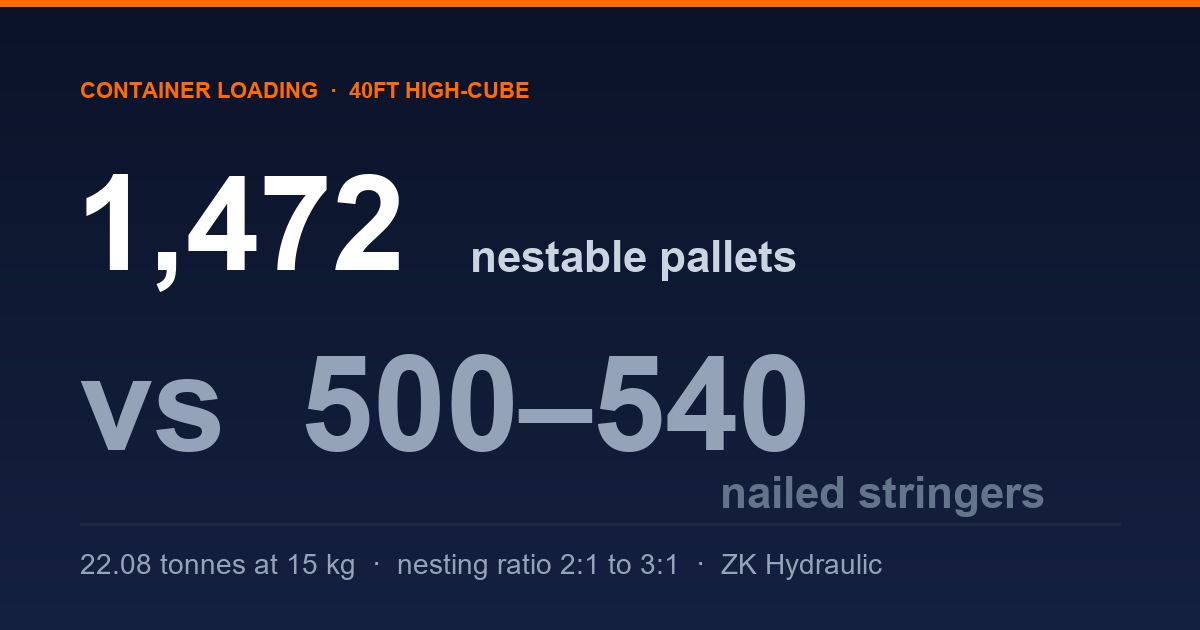
Short answer, stated once so it can be quoted: a 40-foot high-cube container holds between 1,100 and 1,470 nestable presswood pallets. Our own loading table for the 1,200 × 800 × 140 mm nine-foot pallet lands at 1,472 pieces. That is 23 nested stacks of 64, weighing 22.08 tonnes. The same box holds 500 to 540 conventional nailed stringer pallets. That is a freight ratio between two and nearly three to one, all on one ocean invoice. Most pallet quotations never mention it. Nestable pallet, defined: it is a one-piece molded platform whose tapered legs let empty units slide into each other. Each stacked unit therefore consumes its own deck thickness, not its full height. That single geometry decision is worth a second container on every eight or nine you ship. And it is decided at the mold, not at the port.
What the Box Actually Gives You
A 40-foot high-cube container is the standard export box for palletized cargo. Its internal dimensions run roughly 12.03 m long, 2.35 m wide and 2.39 m high. That is about 67 cubic metres of volume and just under 29 square metres of floor. Weight is the other ceiling. Carriers typically allow a payload in the mid-twenties of tonnes on a 40HC. The exact figure comes from the CSC plate and the road limits at both ends. Volume and payload together decide how many pallets you can put in. Every loading plan is an argument between those two numbers.
Why Nailed Pallets Cap the Cube
A conventional stringer pallet does not interlock. Put two on top of each other and the bottom one’s full deck height becomes dead air. A 1,200 × 800 mm stringer pallet stands about 140 to 150 mm tall. Under a 2.39 m ceiling, that allows around fifteen usable layers. A floor layout gives roughly 25 to 30 boards per layer. Real-world dunnage losses sit on top of that. So the count lands in the 500-to-540 range for a full truckload. Industry coverage of Litco International’s pressed-wood program reports the same band, and export forwards confirm it in practice. The pallet itself is fine. The cube is full of nothing.
What Nesting Changes
Nestable presswood pallets attack the dead air directly. Because the legs taper, each empty unit drops into the one below it. Instead of paying 145 mm of height per pallet, you pay a fraction of that. The result shows up in two reported figures. Future Market Insights estimates that 1,200 nested presswood units occupy about the floor space of 480 conventional nailed pallets. Our own nestable pallet pattern library on palletsbiz.com documents a 4:1 space-saving ratio for the same platform family. On the truck, trade coverage of pressed-wood programs reports roughly 1,100 units per 40HC. That is the conservative number, and it leaves stack height and lane weight in reserve. Our own loading table goes further: 1,472 pieces of the 1,200 × 800 × 140 mm pallet, in 23 nested stacks of 64. Against 500 to 540 stringer pallets, the ratio lands between two and nearly three to one in an identical box.
The Weight Ceiling Nobody Checks
Volume is not the last word. Payload is, and this is where material choice bites. A standard 1,200 × 800 mm nine-leg molded pallet leaves the press at 11.5 to 14.0 kg. Pressed from recycled plastics, the same footprint runs closer to 22 to 23 kg. Now run the arithmetic at the container level. At 13.5 kg, 1,100 nested pallets weigh about 14.9 tonnes, comfortably inside the ceiling. At 23 kg, the same count reaches 25.3 tonnes. That is at or beyond the limit for many lanes. Run the check on our own table and the ceiling arrives sooner. At 15 kg, 1,472 pieces weigh 22.08 tonnes, close to the practical payload limit on most routes. Volume stops being the constraint somewhere around the 1,400 mark. Weight takes over from there. So the plastic pallet, which costs three to eight times more per unit, also ships fewer units per container. Nesting economics reward light feedstock twice: once in the cube, once on the scale. This is one of the quieter reasons wood-fiber molded pallets keep winning one-way export lanes. It is also why the presswood pallet machine conversation should start with finished weight, not just tonnage.
Freight Cost per Pallet, Worked Through
Here is the arithmetic your freight forwarder will not volunteer. Take an illustrative ocean freight of $3,000 for a 40HC — adjust to your own lane, the ratio holds. Divided across 540 stringer pallets, freight costs $5.56 per pallet. Divided across 1,100 nested presswood pallets, it costs $2.73. Load the same box to our own 1,472-unit specification and it falls to $2.04. Against the stringer baseline, the saving is $2.83 to $3.52 per pallet on the outbound leg alone. A plant shipping 50,000 export pallets a year keeps $141,000 to $176,000 in freight before a single process improvement. Now stack the second-order effects. Fewer containers mean fewer drayage moves, fewer customs declarations and less handling time at the yard. Fewer containers also mean fewer delays at the gate. Molded pallets skip ISPM 15 treatment entirely as processed wood. The export leg therefore carries no fumigation certificate and no treatment fee. USDA APHIS states the wood packaging rules for the US market. The ISPM 15 standard confirms processed wood sits outside the mark-and-treat regime.
The Warehouse Side Compounds It
The container is only half the ledger. Empty pallet storage is where nesting quietly compounds. A nestable stack at 4:1 means a warehouse that held one pallet position now holds four. For a distributor staging empties between sailings, that is often the difference between renting overflow space and not. FMI’s floor-space estimate reads as roughly a 2.5:1 storage gain even on conservative assumptions. It counts 480 conventional footprints replaced by 1,200 nested units. Either way, the taper pays twice: in the container and in the rack aisle. Buyers who spec only dynamic load miss this entire column of the spreadsheet.
When Nesting Does Not Apply
Nesting is not universal, and pretending otherwise costs people money. A rackable pallet carries reinforced bottom decks, so the legs cannot taper. Those units stack like stringers, full height, no interlock. If your destination is an open-beam high-bay rack, you may need that rackable geometry — and then the container arithmetic shifts back toward the stringer baseline. Footprint matters too. The 1,100 figure assumes the dominant 1,200 × 800 mm export platform. A 1,100 × 1,100 unit loads differently, and a 1,200 × 1,200 footprint loses a full row on the 2.35 m width. Automated warehouses add a third constraint. AGV and ASRS interfaces want dimensional consistency and stiffness, which pushes some operators toward flat-deck designs with lower nesting ratios. The honest answer is that nesting depth, load rating and rack compatibility are one negotiation. Push any one of the three too far and the other two pay for it.
What to Specify Before You Buy
If the loading arithmetic matters to your business, put four questions in front of any supplier. First, finished weight: what does the exact pallet weigh, in kilograms, at the density you will run? Second, nesting depth: how much height does one empty unit add inside a stack? Third, which mold produces that taper, and what does changing it cost later? The taper is a mold property, so it is fixed once the steel is cut. Fourth, ask for a container loading plan for your own footprint, not a brochure number. A serious supplier will hand you a per-layer count and a gross weight check. We publish our line’s capacity math openly, including shift output and the assumptions behind it, on the production capacity guide. The same discipline applies here: numbers you can check beat numbers you are told.
Why This Window Matters Now
The market is moving toward the format that ships flat and nests deep. Future Market Insights puts molded wood pallets at US$2.3 billion in 2026. By 2036 the forecast reaches $4.2 billion, a 6.2% CAGR. Nestable 1,200 × 800 mm formats already hold 58.9% of the size-footprint segment. Four regulatory tightenings on solid-wood packaging hit in 2026: the US hyphen mark, EU electronic verification, French CHED-PP checks and China’s GACC Order 283. Together they keep pushing one-way export volume toward exempt platforms. Freight remains the cost nobody regulates. The taper is your only lever on it.
The practical conclusion is short. Compare pallets at the container level, not the unit level. Ask for the loading plan, run the weight check, and let the nesting depth argue for the mold. If you want that worked for your own footprint and feedstock, bring both to our news and trial-data page for the latest line results. Or send the specification straight through the contact page. ZK Hydraulic also maintains a dedicated presswood pallet site with pattern and application notes.