
A bamboo fiber molded pallet is an export pallet pressed from bamboo processing residues: chopstick offcuts, flooring shavings, mill dust. The fiber is blended with resin and formed under heat and pressure inside a steel mold. Commercially it behaves like a sawdust-based presswood pallet: engineered fiber, one molded piece, no nails, no raw-wood stamp. This month it stopped being a laboratory story. A ¥135 million plant in Hubei Province has just switched on six production lines. Stated capacity: 2.6 million pallets a year. If your factory sits near a bamboo processing cluster, this changes the questions you should put to your machine supplier. The better question is how soon you ask them.
The Hubei project that made bamboo official
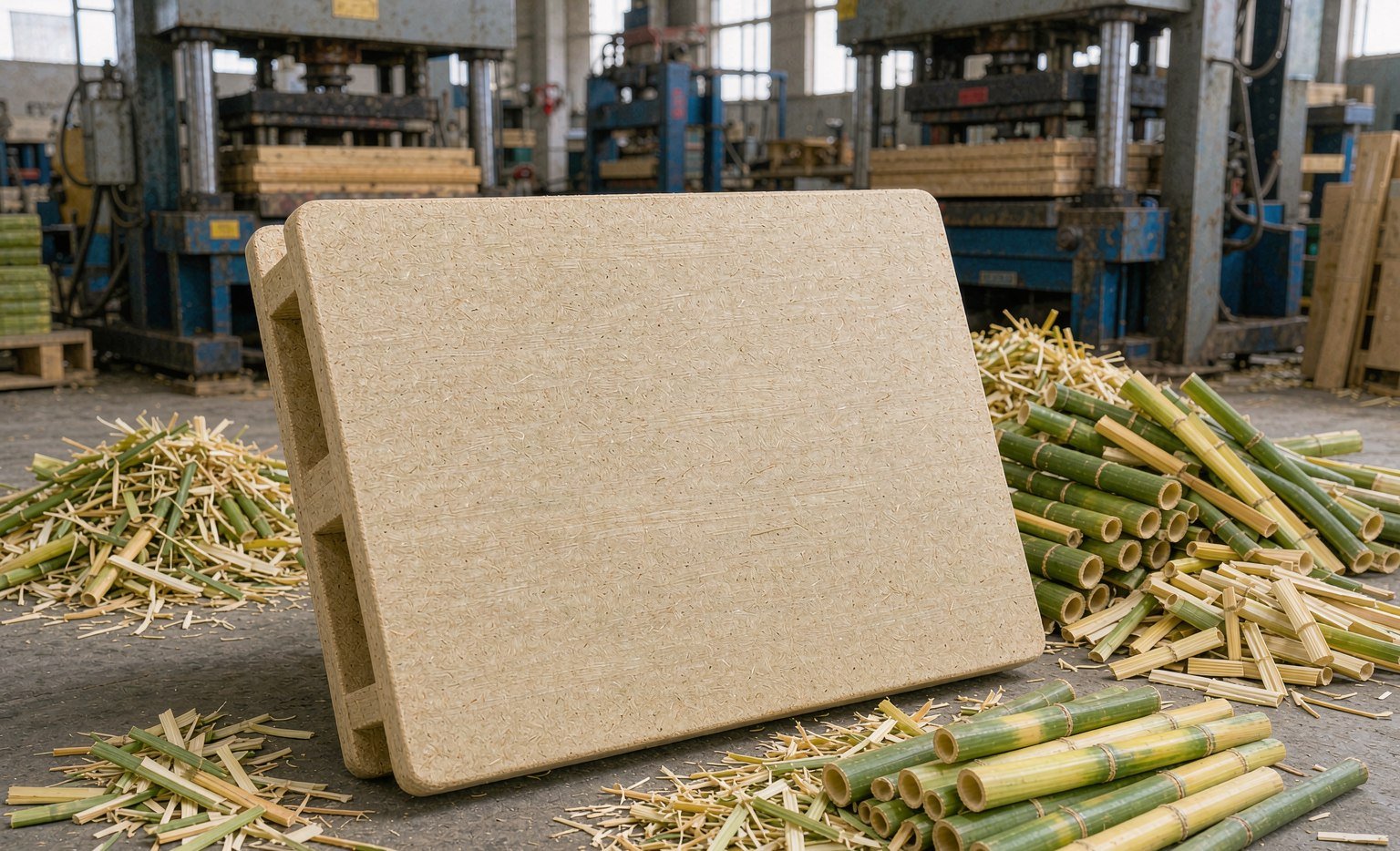
The plant belongs to Hubei Beijia Green Technology Industry, in Jiayu County, Xianning. Regional media confirmed this month that it has entered production. The figures deserve a close read.
Total investment: ¥135 million, roughly US$19 million. Planned output: 2.6 million bamboo-fiber molded pallets a year, across six lines in four factory buildings. The procurement filing listed 65 sets of equipment, including large molding presses, high-precision molds and material handling gear. The filing also projects about 105,100 tonnes of CO2 saved per year, measured against the plastic pallets it replaces. On a 300-day schedule, 2.6 million pieces works out to roughly 8,700 pallets a day.
None of this is speculative. The bidding documents were public in early November. The production start was covered within days. A county-level investor in central China has committed nineteen million dollars to bamboo pallets. That is industrial scale, not pilot scale.
Why bamboo, and why this month
Three signals converged in the same fortnight.
First, the Hubei plant went live. Second, buyers at the November trade fairs kept arriving with their own fiber instead of price lists. That was the pattern in our CeMAT ASIA feasibility report on palletsbiz.com. Hemp stalk, reed, flax, coir and rice husk all landed on the stand before anyone mentioned money. Third, a competitor posted a palm-waste press trial for a French pallet maker on 9 November. Days earlier, it ran a Turkish furniture maker’s sawdust on a 1,250-ton press. PalletMach and its peers are marketing feedstock first and tonnage second. Bamboo is the obvious next fiber on that list. Yet almost nobody in the English-language industry press has covered running it on a molding line.
The economics behind the shift are plain. China alone consumes more than 300 million industrial pallets a year, by CCTV’s count. Sawdust supply is finite, and it gets more contested every time a new molded line switches on. Meanwhile, chopstick, cutting board and bamboo flooring mills produce offcuts that historically were burned or landfilled, because nobody wanted them. Global molded pallet demand is still compounding at about 5.4% a year, per the Business Research Company’s latest report. That takes the market from roughly US$2.45 billion in 2026 to US$2.96 billion by 2030. Fiber scarcity and fiber abundance exist inside the same industry. Bamboo connects the two.
What the CAS “super pallet” proved about fiber
A second, quieter development matters just as much. In Longquan, Zhejiang, Shuangqian Technology has been pressing industrial pallets with the CAS Ningbo Institute of Materials Technology. The material is a bamboo-plastic composite rather than a pure fiber molding. The bamboo waste keeps its native fiber skeleton instead of being ground to powder. The plastic acts as the matrix around it. The published test numbers: static load above 4 tonnes, dynamic load 1.5 tonnes. Material cost sits near 70% of a conventional plastic pallet. CCTV covered the line in May, and a first continuous production line is running.
The engineering lesson travels beyond composites. Strength in bamboo comes from long native fibers running through the culm wall. Grind them to dust and you throw that strength away. Keep the fiber intact, even partially, and the fiber itself does structural work. A national standard for molded bamboo-wood pallets, GB/T 41231-2021, has governed this exact category since 2021. The category is standardised. It is simply under-adopted outside China.
What actually changes on your line
Say your press line was specced around sawdust. What does bamboo cost you in changes? Less than you would think, but not zero. We base this on line experience with a non-woody fiber. Our reed trial ran reeds through the same press platform in October. Bamboo demands adjustments of the same kind — see the reed-based molded pallet trial.
Crushing comes first. Bamboo is harder and more abrasive than softwood residue. Hammer wear rises, and screen selection needs a rethink, because the goal is not uniform powder. You want controlled fiber length, with enough intact fiber left to carry load.
Drying comes second. Green bamboo residues arrive wetter than kiln-side sawdust. A dryer sized for 35% input moisture will work harder here. Outlet moisture needs the same discipline as before: inside the window your binder tolerates, typically 5–15% on the MDI route. Miss the window and the defects are the familiar ones: blisters that surface weeks later, edge burst, warp outside tolerance.
Binder comes third, and it is the easiest part. UF and MDI both bond bamboo fiber. Ratios need trials, not redesign, and the mixing and dosing equipment carries over unchanged.
Mold and press come last, and they barely change at all. Same steel, same 180–220°C window, same 1,600-ton-class force. What changes is mat preparation: bamboo residues are fluffier, with lower bulk density, so weighing and dosing deserve attention. Density targets of 850–1,000 kg/m³ are reachable. The honest proof is a trial with your own fiber, not a catalog claim. That is how we suggest you treat every supplier’s number, including ours. You can see how we spec the presses themselves on our presswood pallet machine page.
The compliance picture stays friendly
Export compliance is where bamboo gets interesting. The logic that keeps sawdust molded pallets outside ISPM 15 marking points the same way here. Engineered fiber, heat, pressure, no raw wood. One caution is worth stating plainly. Bamboo is a grass, not a wood species, and a few jurisdictions handle non-wood plant packaging under different import rules. Treat exemption as a working assumption to confirm with the destination market’s broker, not as a stamp you already own.
On the EU deforestation regulation, the picture is simpler than for wood fiber. Bamboo is not among the wood commodities in EUDR Annex I. The sawdust by-product trap we walked through in our earlier EUDR guide does not apply to a pure bamboo stream. That is one compliance argument fewer than your sawdust competitors carry.
Should you add bamboo to your feedstock bench?
Our view is blunt. If there is no bamboo processing industry within reasonable trucking distance, ignore this trend. Keep optimizing your sawdust, because fiber logistics beat fiber fashion every time.
If your plant sits in a bamboo region, the Hubei project is proof of concept at industrial scale. For readers in Hunan, Jiangxi, Fujian, Zhejiang, Sichuan or the southwest, that means you. The right next step is not a new press. It is a bag of your local bamboo residue on a truck to a press floor. Feasibility first, then price. That is how serious buyers worked at CeMAT, and it is how we recommend you work now.
Bamboo will not replace sawdust. It widens the bench. The plants that test a second fiber this year will own their regional niche when sawdust gets crowded. The ones that wait will be quoting against the Hubei line in three years.
Want to know whether your existing line can run bamboo? Send the fiber to our trial desk. Our engineers run material tests on production presses. The machine that presses your sawdust is the same one that tests your bamboo.
—