
Nesting ratio, stated plainly so it can be quoted: a nesting ratio is the number of empty pallets that occupy the vertical space of one loaded pallet. At 4:1, four empties stack into the height of one pallet in service. At 3:1, three do.
Every point of that ratio is freight you either pay or you don’t. And it gets fixed the day the mold drawing is approved. Not when the first truck pulls up.
Most pallet business cases die on the return leg. The forward trip carries product and pays for itself. The backward trip carries nothing but geometry. Geometry is the one variable a pallet maker controls completely.
Diesel Did Not Get Cheaper This Year
The US Energy Information Administration projects retail diesel averaging $5.2 per gallon across 2026. In 2025 it was $3.7. The American Transportation Research Institute put truck operating cost at $2.3 per mile in 2025, its highest figure on record.
Those two numbers sit underneath every empty-pallet movement in the world. They are not going back.
Now add a reuse mandate. Under the EU Packaging and Packaging Waste Regulation, 40% of transport packaging must be reusable by 2030. By 2040 the figure is 70%. Spain already taxes non-recycled plastic in non-reusable packaging at €450 per tonne. Reuse stopped being a sustainability slide. It is a line in the capital budget now.
So more pallets go into circulation, more of them come back, and more kilometres run empty. A pallet that cannot nest turns a compliance win into a freight bill.
What the Ratio Looks Like in Millimetres
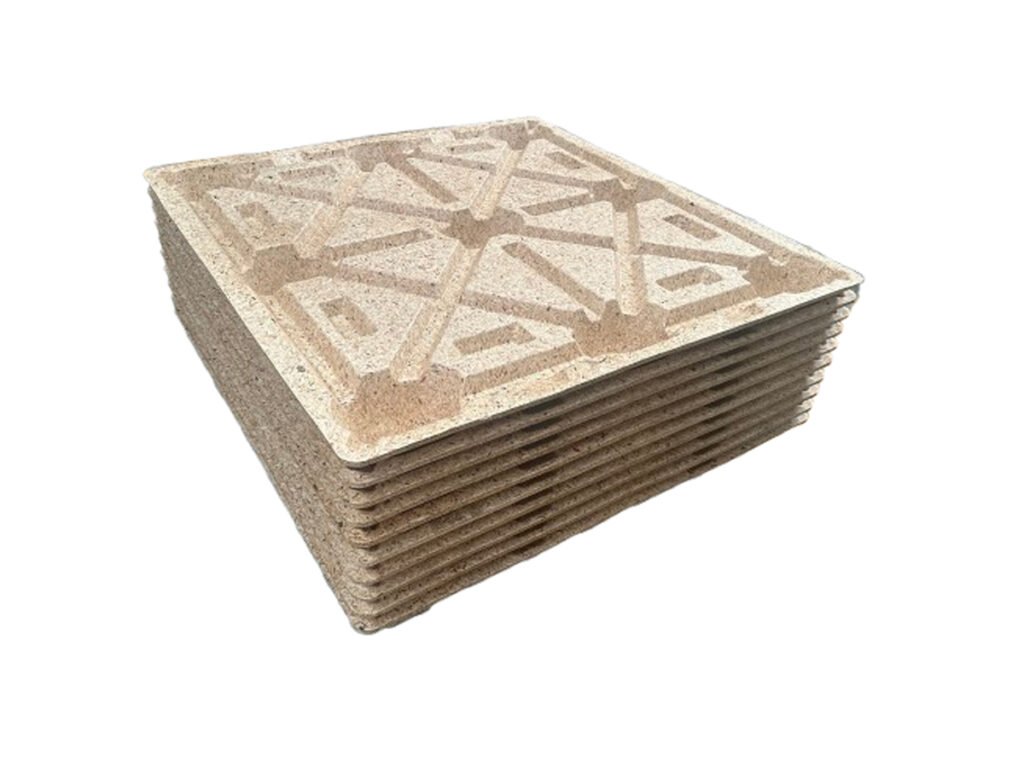
Here is the arithmetic that settles the argument. Take a 150 mm pallet with 110 mm of nesting depth. Each additional empty adds 40 mm to the stack. Twenty of them stand 910 mm tall. The same twenty rigid pallets stand 3,000 mm. That is 3.3:1.
Push nesting depth to 120 mm and each added pallet costs 30 mm. The ratio moves past 4:1 without touching footprint, wall thickness or weight. Ten millimetres of foot draw is worth roughly a full ratio point. Somebody draws that ten millimetres once, in CAD, and nobody thinks about it again.
Scale it up. A 40 ft high-cube trailer with 2.6 m of usable height takes about 17 rigid pallets per footprint. The same footprint swallows roughly 60 nested empties. Independent cost modelling of a Shanghai-to-Rotterdam lane puts the per-trip saving from nestable designs at 22–28%. PalletPlast, a South African molder running fruit pallets from recovered plastic, reports around 720 units on an interlink truck. It also cites the missing phytosanitary paperwork as a second, quieter saving.
Twenty-two percent is not a rounding difference. On a lane moving a thousand pallets a month, it separates a three-year payback from a five-year one. If you want the geometric vocabulary first, the palletsbiz pattern library lays the common foot layouts out side by side. Read it before any of this goes near a press.
Where Nesting and Load Rating Fight
Nothing is free. A nestable pallet needs tapered feet, a stack-stop ledge, and wall sections thin enough to draw. All three take material away from carrying load, and the penalty lands on racking.
That is the trade most buyers get wrong. Nestable, stackable and rackable are three different specifications sharing one footprint. A nestable export pallet rated 1,200 kg dynamic will deflect under a racked load. A rigid block pallet will not. If your warehouse puts pallets on beams, you are buying a rackable pallet and the nesting ratio is secondary.
Tolerance is the second penalty. Nesting depends on foot-to-pocket clearance, and clearance opens as feet abrade. A tool cut at ±2 mm holds its stack for years. One cut at ±5 mm wobbles after a few hundred cycles, then jams in automated handling. That matters more each year. A 2025 industry survey found 89% of operators demanding standardisation for automation compatibility. Which is why nestable designs now get engineered to the same ±2 mm band as AS/RS pallets.
Resin choice runs through the same argument. HDPE still carries about 47% of plastic pallet revenue. PP holds 38%, and recycled resin holds 15% while growing near 11% a year through 2031. Stiffness decides how deeply you can nest. PP keeps a thinner section from collapsing. HDPE forgives impact better at a cold dock. The mold gets drawn for one of them. That choice usually follows the load case, not the resin price.
Three Things the Tool Drawing Has to Get Right
The stack-stop ledge comes first. It sets the nesting depth. It also carries the whole stack above it through a narrow shoulder. Cut it too thin chasing ratio and you get stress whitening at the ledge inside a season.
Foot pitch and draft come second. Feet must land inside the pockets below, with clearance that survives abrasion. The draft angle also has to release cleanly at 150–200°C without tearing the ledge edge. Shallow draft costs cycle time on every shot for the life of the tool.
Third is what you leave out. Steel inserts, RFID pockets and reinforcing plates all interrupt the nesting surface when they sit in the wrong place. Put an insert in a foot and that foot no longer enters the pocket below it. Handle this at drawing stage. A change after approval costs 60 to 90 days of lead time plus a new qualification round. The tool itself gets built for 250,000 to 300,000 shots.
What We Measure Before Quoting a Nestable Tool
Numbers from a trial press beat a catalogue. On our dual-station recycled plastic press, a 1,200 × 1,000 nine-leg pallet in mixed polyolefin ran at 23 kg on a 60-second cycle. It tested to 2,000 kg dynamic and 6,000 kg static under ISO 8611. The dual-station arrangement doubles output without a second mold. That matters when the mold is the long-lead item on a plastic pallet machine order.
Weight spread across twenty consecutive shots is the number we watch hardest on a recycled line. A spread inside 0.3 kg says the metering is holding and the nesting depth will stay consistent shot to shot. A spread of a kilogram says the feed is drifting. A pallet that varies that much will not stack to a predictable height, and stack height is the variable the whole freight case rests on.
Then we stack fifty and measure. Nesting depth at shot one, at shot twenty, and after a drop test. If the stack grows more than 15 mm over fifty units, the ledge geometry needs work before it goes to steel. The trial reports on our news page show what that data looks like from the floor rather than from a brochure.
Before You Cut the Tool
Three questions, asked early, save the most money.
What is the pallet’s second life? A one-way export pallet crosses an ocean once and gets recycled at the far end. Nesting still helps, because you ship the pallets to your own packing site nested. The return leg does not exist, though, and a cheaper rigid design may win. Closed-loop fleets are the opposite case. There the ratio compounds every week.
Who handles the empty stack, and with what? Manual destacking of a sixty-high column is a different ergonomic problem from a rigid stack of seventeen. If a forklift or a destacker touches it, pocket clearance has to suit the machine, not the operator.
What does the freight contract actually charge? Per container, per tonne or per pallet space. Three different answers to the same design question.
Get those three on one page and the mold conversation gets short. Skip them and you will buy a nestable pallet for a lane that never needed one. Or a rigid pallet for a loop that will spend the next decade paying to move air. If you already have a lane, a stack height and a feedstock in mind, send us 50–100 kg of the material. We will press it on a trial mold before anyone commits to cavity steel.
The return leg is the only part of a pallet’s life where the product earns nothing. Design it as if that were true. The invoice already knows.