
Presswood pallet machine tonnage is one of the most important factors when selecting hydraulic equipment for molded wood pallet manufacturing. However, choosing a press based only on pallet dimensions or the machine’s advertised tonnage can lead to incorrect equipment selection, unnecessary investment, or production limitations.
A suitable hydraulic press must be matched with the pallet mold, projected molding area, required forming pressure, material characteristics, heating system, and target production capacity.
This guide explains how to evaluate hydraulic press tonnage, calculate theoretical forming force, compare different machine configurations, and identify the engineering details that should be confirmed before purchasing a presswood pallet production machine.
1. What Does Tonnage Mean in a Presswood Pallet Machine?
The tonnage of a hydraulic press represents its nominal pressing force.
For example, a 1000-ton hydraulic press is designed to generate a nominal pressing force of approximately 1000 metric tonnes-force under its rated operating conditions.
It does not mean that the hydraulic system pressure is 1000 tons.
These are two different engineering parameters.
Hydraulic pressure describes the pressure of the hydraulic oil inside the system.
Pressing force describes the total force generated by the hydraulic cylinders and transmitted through the press structure to the mold.
The relationship is:
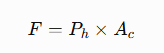
Where:
- \(F\) = hydraulic pressing force.
- \(P_h\) = hydraulic oil pressure.
- \(A_c\) = total effective piston area.
For a machine with multiple cylinders, the effective piston areas must be added together, accounting for the working direction of each cylinder.
This distinction is important because two machines with the same nominal tonnage may have different cylinder configurations, hydraulic operating pressures, frame structures, and performance characteristics.
2. How to Calculate the Required Pressing Force
The basic engineering relationship between forming pressure and projected area is:
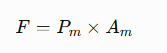
Where:
- \(F\) = required pressing force.
- \(P_m\) = target average molding pressure.
- \(A_m\) = effective projected molding area.
When pressure is expressed in MPa and area in mm², the required force is obtained in newtons.
To convert this force into metric tonnes-force:
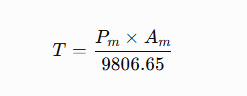
Where:
- \(T\) = required theoretical force in metric tonnes-force.
- \(P_m\) = pressure in MPa.
- \(A_m\) = projected area in mm².
This formula provides a preliminary engineering calculation, not a complete machine-selection specification.
Practical example: 1200 × 1000 mm pallet
Assume a presswood pallet mold has a projected working area of:

Assume, purely for illustration, that the engineering trial establishes a target average molding pressure of 12 MPa.
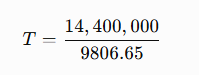
The theoretical force becomes:
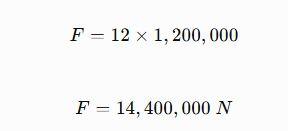
Converting to metric tonnes-force:
Illustrative theoretical pressing force
1,468.4 T
Based on a hypothetical 12 MPa target over 1.2 m².
This calculation does not automatically mean that a 1600-ton press is the correct choice.
The assumed molding pressure must first be verified through material trials and mold engineering. The final machine selection must also consider load distribution, frame stiffness, cylinder arrangement, mold strength, and the required engineering allowances.
Important: The projected loaded area must be defined by the actual mold and forming arrangement. It should not automatically be replaced with the entire platen area or an unrelated pallet dimension.
3. What Factors Determine the Required Tonnage?
Machine tonnage is only one part of the selection process.
Several engineering variables must be evaluated together.
A. Pallet dimensions
Larger pallets generally require larger molds and may require greater total pressing force, depending on the effective forming area and process conditions.
Typical pallet dimensions include:
| Pallet size | Common application |
|---|---|
| 1200 × 1000 mm | General industrial logistics |
| 1200 × 800 mm | European logistics |
| 1100 × 1100 mm | Asian industrial applications |
| 1140 × 1140 mm | Container and industrial applications |
| 1200 × 1200 mm | Large industrial applications |
These dimensions are not direct indicators of the required press tonnage.
Two pallets with the same outside dimensions may have very different mold geometries, wall thicknesses, reinforcing structures, and material distributions.
B. Pallet structure

Different pallet structures require different mold configurations.
Common types include:
- Nine-leg nestable pallets.
- Flat-surface pallets.
- Rackable pallets.
- Stackable pallets.
- Double-deck pallets.
- Customized heavy-duty pallets.
A nine-leg pallet and a double-deck pallet may have the same external dimensions but different internal structures.
Their projected molding areas, mold arrangements, material distribution, and pressing requirements may therefore differ.
C. Raw material characteristics
Raw material is another important consideration.
Common feedstocks include:
- Wood sawdust.
- Wood chips.
- Wood shavings.
- Rice husks.
- Wheat straw.
- Coconut fiber.
- Palm residues.
- Hemp stalks.
- Flax stalks.
- Other agricultural residues.
These materials are not interchangeable.
For example, rice husks have different particle structures from wood shavings, while long agricultural fibers can behave differently during material spreading and mold filling.
Material characteristics influence:
- Bulk density.
- Material flow.
- Mold filling.
- Adhesive distribution.
- Moisture behavior.
- Finished product density.
- Demolding performance.
Consequently, the required machine configuration should be evaluated using the actual raw material rather than relying exclusively on conventional sawdust production data.
D. Mold structure and cavity arrangement
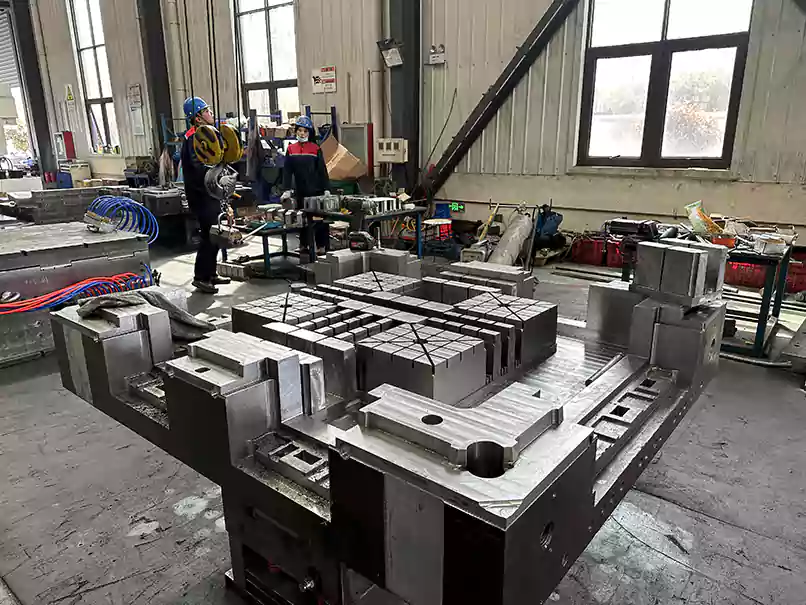
The mold is one of the most important components in the entire production system.
Its design determines the final pallet geometry and influences how pressure is distributed during molding.
Engineering considerations include:
- Mold dimensions.
- Cavity depth.
- Wall thickness.
- Internal reinforcing structures.
- Heating channel arrangement.
- Mold opening and closing movement.
- Material distribution.
- Demolding requirements.
A multi-cavity mold must be evaluated using the combined projected working area and its actual load distribution.
A larger machine is not necessarily a better solution if the mold design and working configuration are unsuitable.
For customized tooling, see ZK Hydraulic’s Presswood Pallet Mold Manufacturing.
4. Comparing Different Presswood Pallet Machine Tonnages
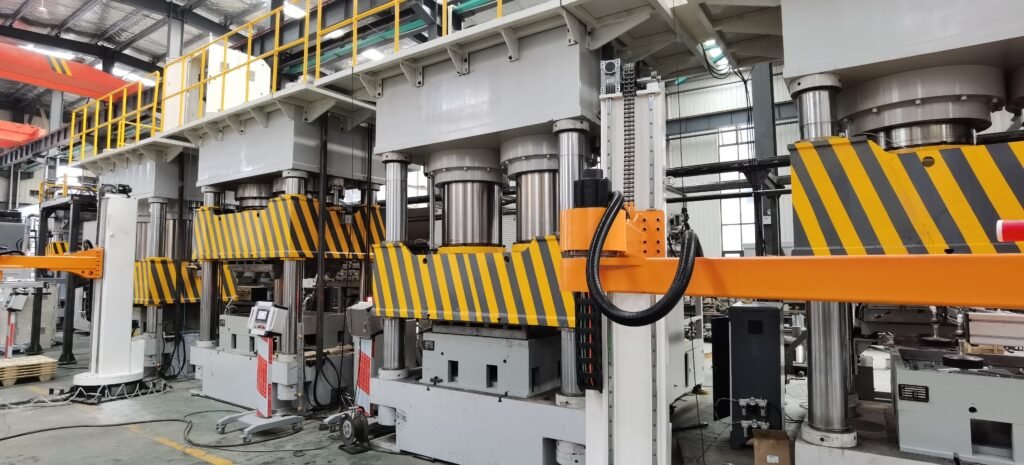
Different machine sizes serve different production requirements.
The following table provides a general equipment-selection framework rather than a universal specification.
| Machine tonnage | Typical selection consideration |
|---|---|
| 800–1000T | Smaller or appropriately designed pallet molds |
| 1250T | Medium-sized production requirements |
| 1600T | Larger or more demanding molding configurations |
| 1800–2000T | Larger molds and higher force requirements |
| 2500–3000T | Large-format or specialized industrial pallets |
The actual suitability of each machine must be confirmed through engineering calculations and mold trials.
ZK Hydraulic publishes multiple hydraulic press models, including 1000T, 1250T, 1600T, 1800T, 2000T, and 3000T configurations.
Explore the ZK Hydraulic Presswood Pallet Machine Range.
Why should you avoid selecting a machine based only on tonnage?
Consider two machines, both advertised as 1600 tons.
They may have different:
- Working table dimensions.
- Platen thickness.
- Cylinder arrangements.
- Maximum opening height.
- Slide stroke.
- Heating arrangements.
- Hydraulic pump configurations.
- Frame stiffness.
- Automation systems.
Therefore, nominal tonnage alone cannot establish which machine is better suited to a specific production project.
5. Five Important Machine Specifications Beyond Tonnage
When comparing hydraulic presses, buyers should pay attention to the following specifications.
1. Working table dimensions
The working table must accommodate the mold safely.
It is important to consider the mold’s external dimensions, mounting arrangement, and available space for heating connections.
2. Maximum opening height
The maximum opening height determines the available space between the upper and lower working surfaces when the press is fully open.
This must accommodate the mold structure, pallet thickness, demolding equipment, and maintenance requirements.
3. Slide stroke
The slide stroke determines the available movement of the upper platen.
An unsuitable stroke may limit mold installation, product removal, or future mold modifications.
4. Frame structure
The frame must withstand the designed pressing load while maintaining appropriate structural stiffness and platen alignment.
For high-tonnage hydraulic presses, the following deserve particular attention:
- Column diameter.
- Beam dimensions.
- Frame material.
- Stress relief.
- Platen deformation.
- Guide arrangement.
- Load distribution.
Frame stiffness is important because excessive deformation can affect mold alignment and product consistency.
5. Hydraulic and electrical systems
The hydraulic system determines how the machine generates and controls pressing force.
The electrical control system determines how the production sequence is executed.
Important features include:
- Hydraulic pump capacity.
- Servo or conventional hydraulic drive.
- Pressure control.
- Speed control.
- PLC programming.
- Temperature monitoring.
- Safety light curtains.
- Mechanical safety locks.
A properly designed control system should support the required fast approach, slow closing, pressing, holding, and opening sequence.
6. How to Match Machine Tonnage with Production Capacity
Selecting the right tonnage does not automatically guarantee the required production output.
The actual production capacity depends on the complete production cycle.
A typical presswood pallet production line includes:
- Wood chipping.
- Material crushing.
- Drying.
- Adhesive mixing.
- Material weighing and spreading.
- Hydraulic hot pressing.
- Automatic demolding.
- Pallet cooling and stacking.
The production capacity is influenced by:
- Pressing cycle time.
- Mold cavity quantity.
- Material preparation capacity.
- Material feeding time.
- Heating stability.
- Demolding time.
- Operator efficiency.
- Equipment availability.
A high-tonnage machine with slow material feeding can produce less than a properly configured smaller machine.
For this reason, customers should evaluate the complete production line rather than purchasing a hydraulic press based on tonnage alone.
See PalletsBiz’s Presswood Pallet Production Process Guide for more information about the production stages.
7. Why Mold Temperature and Heating Systems Matter
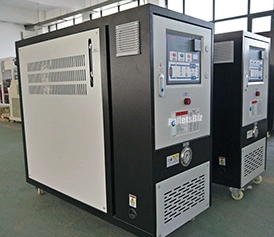
Presswood pallet manufacturing is a thermal compression process.
The heating system must be designed according to the adhesive, material, mold structure, and required production cycle.
Common heating arrangements include:
- Steam heating.
- Thermal oil heating.
Temperature distribution across the mold is important because different mold areas should experience sufficiently consistent curing conditions.
Even if a press has sufficient nominal force, an unsuitable heating arrangement can affect product quality and production stability.
The machine, mold, and heating system should therefore be designed as one integrated production system.
8. How to Verify the Finished Pallet Quality
A hydraulic press should not be selected only by theoretical force calculations.
The finished pallet must be tested against its intended application.
Important inspection items include:
| Test item | Purpose |
|---|---|
| Dimensions | Confirm dimensional accuracy |
| Weight | Check material consistency |
| Moisture | Evaluate finished product condition |
| Surface quality | Identify cracks and defects |
| Static load | Evaluate stationary load performance |
| Dynamic load | Evaluate handling performance |
| Rack testing | Evaluate suitability for the specified racking arrangement |
| Durability | Compare performance after repeated loading |
For technical reference, ISO 8611-1:2025 specifies test methods for nominal load, maximum working load, and durability comparison of flat pallets.
The standard also makes clear that testing does not eliminate the value of field evaluation for specific pallet designs. Part 1: Test methods
This is why the final machine and mold configuration should be validated through actual production trials.
9. Common Mistakes When Purchasing a Hydraulic Press
The following mistakes can create unnecessary investment and production difficulties.
Mistake 1: Choosing the largest machine available.
Higher tonnage does not automatically mean higher productivity or better product quality.
Mistake 2: Ignoring mold dimensions.
The working table, opening height, and mold mounting arrangement must be checked before ordering.
Mistake 3: Using another factory’s parameters without testing.
Different materials and adhesives may require different processing conditions.
Mistake 4: Ignoring the heating system.
Insufficient heating capacity or poor temperature distribution can create production problems even when the press has adequate force.
Mistake 5: Comparing only the machine price.
A complete investment calculation should include the mold, auxiliary equipment, electrical supply, installation, commissioning, and ongoing maintenance.
10. What Information Should You Provide Before Requesting a Machine Quotation?
To recommend a suitable press, the engineering team should receive the following information.
| Information | Required details |
|---|---|
| Pallet dimensions | Length, width and height |
| Pallet structure | Nine-leg, flat, rackable or double-deck |
| Pallet weight | Target finished weight |
| Load requirements | Static, dynamic and racking requirements |
| Raw materials | Sawdust, wood chips, hemp, rice husk, etc. |
| Material moisture | Incoming and target processing conditions |
| Adhesive | UF, MUF, MDI or other system |
| Target capacity | Pallets per hour or per shift |
| Factory utilities | Voltage, frequency and available power |
| Automation | Semi-automatic or fully automatic |
With these details, the supplier can evaluate the required pressing force, mold configuration, heating system, and complete production-line arrangement.
At ZK Hydraulic, press manufacturing and customized mold engineering are integrated into the equipment development process.
This allows the machine configuration to be evaluated together with the actual pallet design and production requirements.
You can also review ZK Hydraulic’s presswood pallet machine specifications and custom pallet mold capabilities.
Frequently Asked Questions
Q1: Is a 1000-ton press sufficient for a 1200 × 1000 mm presswood pallet?
It depends on the pallet structure, mold design, projected molding area, required pressure, and raw material. The outside dimensions alone cannot determine the correct tonnage.
Q2: Is a 1600-ton press better than a 1000-ton press?
Not necessarily. A 1600-ton machine offers greater nominal pressing force, but the best choice depends on the actual production requirements and equipment configuration.
Q3: Does hydraulic oil pressure equal pallet molding pressure?
No. Hydraulic oil pressure generates cylinder force. The average molding pressure is determined by dividing the transmitted pressing force by the effective projected molding area.
Q4: Can one press produce different pallet sizes?
Yes, provided the machine’s working table, opening height, stroke, force, and mold configuration are suitable for the different products.
Q5: Should the mold be designed before selecting the hydraulic press?
The mold and press should be developed together. Preliminary pallet specifications and material requirements should be established before finalizing the equipment configuration.
Q6: Does higher machine tonnage guarantee higher pallet load capacity?
No. Finished pallet load capacity depends on the entire product design, material, adhesive, molding process, and test results.
Conclusion
Selecting the right presswood pallet machine tonnage requires more than comparing the numbers printed on machine specifications.
The correct equipment must be engineered around the pallet dimensions, mold structure, projected molding area, material characteristics, required forming pressure, heating system, and production targets.
A properly matched hydraulic press and mold can provide stable forming conditions, consistent product quality, and reliable production performance.
At ZK Hydraulic, the objective is not simply to supply a high-tonnage hydraulic press, but to develop an integrated machine and mold solution that meets the customer’s actual manufacturing requirements.