
It starts the same way every time. A pallet leaves the press with one crushed foot. Then another. The operator blames the fiber batch, checks moisture, checks glue ratio, and four hours later somebody lifts the ejector frame and finds a core pin sheared clean at the base. The pin is a forty-dollar part. By the time anyone sees it, the line is already down.
What follows is not a repair problem. It is a planning problem, and most plants only discover it once. A replacement pin has to be turned to the original drawing, or a whole set has to be shipped. If the plant sits in Europe and the tool was cut in Henan, the box clears customs in four to six days by air — nine if the pin is not a stock item and the toolroom has to run a short batch. Meanwhile two shifts stand idle, the dryer cools down, and every promise on the order book slides.
What a Presswood Pallet Mold Actually Is
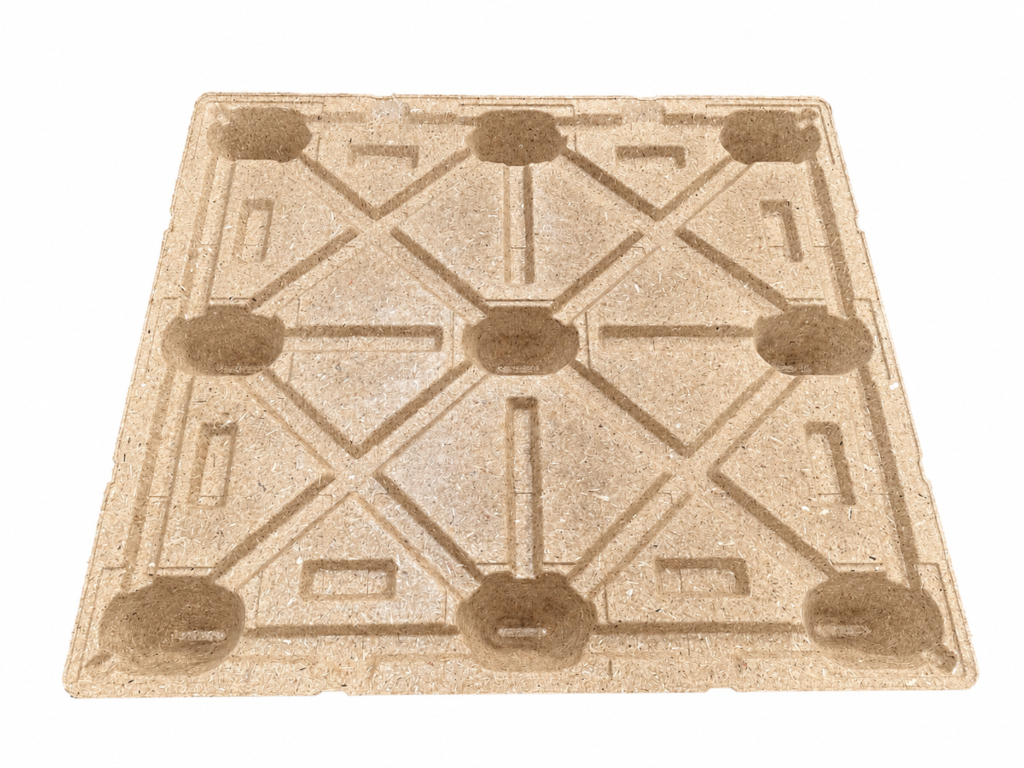
A presswood pallet mold is a matched set of tooling — upper plate, lower plate, core pins, ejector frame — cut from H13 tool steel at 48–52 HRC and built to one pallet geometry. It weighs 2 to 6 tonnes depending on footprint. It is the only component in the plant that decides what the plant can sell. The press sets force and temperature. The mold sets the product.
That distinction matters commercially far more than it does technically. A 1,600-ton press is broadly the same machine whoever builds it: four columns, a platen, a hydraulic power unit. Two suppliers quoting the same tonnage are quoting close to the same iron, and the presswood pallet machine itself is rarely where a project goes wrong. The mold is not interchangeable. Rib layout, draft angles, foot height, shrinkage allowance and core positions are fixed once, in a drawing, before a single pallet exists. Change your mind about deck thickness after the plate is cut and you buy a new plate. The same logic runs through a pallet block machine: the press is the commodity, the die is the product.
And a mold wears out. H13 at that hardness survives roughly 250,000 to 300,000 press cycles before wear starts showing up in the pallet — flash at the parting line, rounded rib edges, feet that no longer sit flat. On a two-shift line that is about two and a half years of production. Every plant buying a molded pallet line is therefore also buying a tooling replacement cycle, whether or not anyone wrote it into the business plan.
The Lead Time Nobody Puts in the Timeline
Most project schedules are built backwards from the press. Wrong anchor.
A 1,600-ton press has a build time measured in weeks and, in a normal year, a slot in the builder’s production plan. A mold has a build time measured in drawings, machining hours and heat treatment, and none of it can start until somebody signs the geometry. In practice the sequence runs: two to three weeks of drawing review and shrinkage sign-off, ten to sixteen weeks of machining, wire EDM and nitriding, then five to seven weeks of sea freight in a crate that has to double as its own lifting frame. Fourteen to twenty weeks door to door, and that assumes nobody changes the foot design in week six.
A buyer who signs the press contract in January and starts talking about tooling in March has not bought a line. He has bought a press and rented a delay. The capacity arithmetic on our production capacity page all rests on the assumption that a mold exists; remove it and the numbers collapse to zero.
Which is why the drawing sign-off meeting matters more than the machine acceptance test. Every figure that will define the product for the next 250,000 cycles gets fixed there: the shrinkage allowance for a 900 kg/m³ density, the draft on the ribs so the pallet releases without tearing, the foot height that decides whether it nests four to one or two to one, the core positions that decide where a forklift entry lands. Get those wrong and the press will faithfully make the wrong pallet, several hundred times a day.
The Spares List That Never Gets Written
Ask a new line owner what he holds in the store and you usually get a list of hydraulic seals. That list protects the press. Nothing on it protects the mold.
The parts that actually stop production are small and unglamorous: core pins, ejector plate bushings, heater cartridges and thermocouples for the platens, proximity switches on the ejector stroke, nozzle tips on the release-agent sprayer, and the insulation board between platen and mold that quietly degrades until the top plate runs cold and every pallet surface starts to pick. None of them cost much. All of them have a lead time measured in days, and the days are the expensive part.
A workable rule: one complete spare pin set, one ejector bushing set, two of every sensor on the mold, one spare insulation board — held as a condition of the purchase order, not an afterthought. Budget 1.5 to 2 percent of the mold value a year. That is a rounding error next to the alternative.
What Nine Days Actually Costs
Numbers, because this argument only lands with numbers.
A line running 350 pallets a day loses 3,150 pallets in nine days. At a selling price of €8 to €12, that is €25,000 to €38,000 of output that never existed — and that is the optimistic version, because it ignores the customer who moves a repeat order to a competitor and never moves it back. Add air freight, the overtime to claw the schedule back, and the fiber that sat in the mixer waiting. The forty-dollar pin is roughly one-thousandth of the loss it caused.
The same arithmetic explains why a second mold is usually a better purchase than a second press. One mold means one SKU. A changeover runs four to eight hours — a shift, plus the scrap from the first hour of re-stabilisation. Two molds on one press can serve two sizes or two customers without ever going dark. Two presses and one mold can only make more of the same thing, and they all stop dead the day that mold cracks.
An opinion, since you asked: below roughly 120,000 pallets a year, the second mold earns its money before the second press does. The exception is a plant already running flat out on a single SKU under a contract that guarantees the volume. Most plants are not that plant.
The Market Just Made the Delay More Expensive
Now the part that connects to this week’s news. European sawlog prices have eased — fresh spruce sawlogs quoted at €115–120/m³ in regional autumn contracts, pine at €82–90/m³, per a 3 November report from Timber Industry News. Canfor’s third-quarter results point the same way, guiding European lumber pricing to soften modestly through the fourth quarter while UK pressure spreads into Central Europe.
That will tempt a few finance directors to postpone a pallet line, on the theory that pallets are about to get cheaper. Wrong read, twice over.
First, construction lumber and pallet lumber are not one market, and a 4 percent move in spruce tells you nothing about the treatment, documentation and inspection costs that make up the compliance half of a solid-wood pallet’s price. China’s GACC Order 283 came into force on 1 November, the fourth tightening of wood-packaging rules in twelve months, and the exemption that processed wood enjoys under ISPM 15 is untouched by any of it.
Second, timing. Transpire Insight puts the presswood pallet market at US4.26 billion in 2026 rising to US6.47 billion by 2035, a 6.25 percent CAGR, with North America holding 37.3 percent of demand. A market growing at that rate does not wait for a procurement committee to feel comfortable. If the mold needs fourteen to twenty weeks and the building work needs four months, a decision deferred to spring delivers the first saleable pallet in the third quarter. Two quarters of softer lumber is not a saving. It is a season.
What to Put in the Purchase Order
Five things, none of them about price.
Ask for the as-built drawing rather than the concept drawing, and check that the shrinkage allowance is stated for the density you actually intend to run. Ask whether a spare pin set and ejector bushings sit inside the mold price — and if the answer is “available on request”, ask for the price list and its validity in writing. Ask for a hardness certificate for the plate and the nitriding depth, because 48–52 HRC is a claim until somebody produces a test report. Ask for a first-off dimensional report on three consecutive pallets, measured at four corners and the centre, not one sample photographed on a pallet jack. And ask who owns the drawing file if you ever want a second source.
That last question is the one suppliers dislike, which is exactly why it belongs early in the conversation. A mold you cannot re-order from anyone else is not an asset. It is a dependency with a delivery date.
The press gets the site visit and the acceptance test; the mold gets a paragraph in the annex. Reverse that order and the nine-day outage turns into a four-day one. Trial reports from lines already running — including what happens when a new fiber meets an existing tool — are collected on our news page, and if you would rather test your own material before any drawing gets cut, send a sample to the factory and we will run it on a production press.
A spare part is not insurance against bad luck. It is insurance against arithmetic you already know.