
Pooled fleets lose 10–15% of their returnable pallets, crates and cages every year. In the United States alone, that shrinkage produces a replacement bill of roughly $1 billion annually. The industry’s answer in 2026 has been to give every asset a radio identity. Container Centralen clipped RFID tags across a 5.5-million-unit roll cage fleet. PECO launched an RFID-enabled pallet line. Poolers across Europe and North America are wiring dock portals into their WMS systems. The tag is no longer an accessory. It is becoming part of the pallet specification. That change lands on the mould drawing, not on the packing slip.
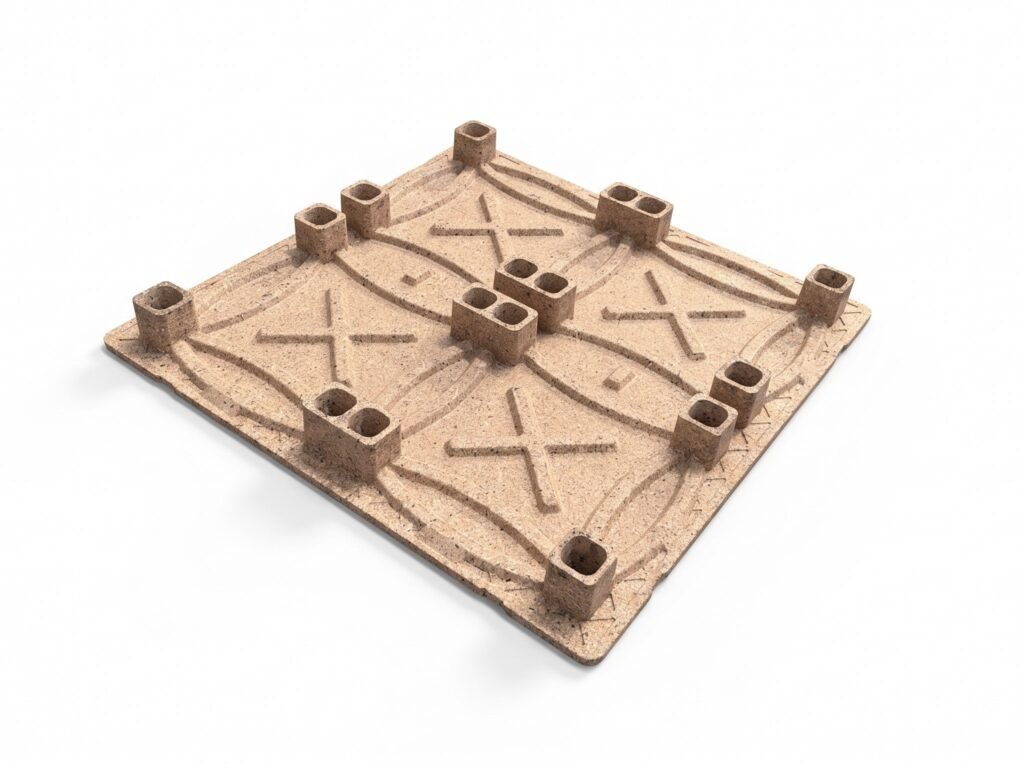
An RFID pocket is a recess cast into the pallet during compression moulding. It is sized to a specific UHF hard tag and sealed with a potting compound after demoulding. The tag sits inside the plastic body instead of on its surface. A pallet built this way carries its identity through hot wash-downs, freezer cycles, forklift scuffs and ten years of handling. A pallet with a stuck-on label rebuilds that identity every few months, or quietly loses it.
Why stick-on tags die on a molded recycled pallet
The failure list is short and predictable.
Recycled mixed PP/PE has a rough, slightly waxy surface. Pressure-sensitive adhesives bond poorly to it even at room temperature. Wash-downs finish the job. One food logistics deployment documented tag failures after six months of daily hot-water washing. The tags survived moisture but not thermal cycling between wash and freezer. Adhesive labels in cold rooms let go near −25°C. Cable-tied tags shear off the first time a forklift heel clips the corner. Barcode labels abrade to nothing inside twenty handling cycles.
A hard tag solves most of this, which is why rugged anti-metal UHF tags now dominate the reusable-asset market. But a hard tag still has to be attached. Glue, rivets and cable ties all put a human and a consumable between the pallet and its identity. That happens once per pallet, forever.
There is a cheaper moment to solve this: the moment the mould is drawn.
The pocket costs nothing at tooling stage
A steel pallet mould runs 250,000 to 300,000 cycles before rework. That is roughly two and a half years of two-shift production. Adding a 40 × 25 mm recess to the corner block cavity costs a few hours of machining. Do it at the CAD stage and it adds no cycle time. The pocket presses in with every shot. The tag drops in and gets potted in seconds as part of normal handling. Alternatively, the customer pots tags in a secondary step with a dispensing gun.
Adding the same pocket later means a mould rework job: press downtime, machining and a new trial round. The approved pallet sample needs requalification too. Or it means retrofitting finished pallets one by one — drilling, bonding, curing, labouring. The retrofit route has a documented failure mode already. One German 3PL bought 35,000 standard RFID inlays for a facility with mixed steel and plastic racking. Read rates on the metal positions collapsed below 50%. The company ended up replacing about 40% of the tags. Re-tagging labour and material came to 1.6 times the original tag spend.
Tag prices make the in-mould route easy to justify. Anti-metal UHF hard tags run $0.20–0.50 at thousand-piece volumes from Chinese suppliers, and ABS-cased rugged tags land at $2.50–5.00. Indian market listings for reusable pallet tags sit at ₹80–400 each. A pooled pallet sells for $12–19 and circulates for a decade. Even the expensive tag is under 3% of asset cost. The pocket is free. The only real cost is deciding before the tool is cut.
The loss math that pays for the tag
The pooler’s arithmetic is blunt. A fleet of 100,000 pallets losing 8% a year at $10 replacement cost burns $80,000 annually. Industry case work puts passive RFID tags at roughly $1 per pallet in that scenario, cutting loss to 3%. That is a $50,000 annual saving against a $100,000 investment, or about a two-year payback. Data from the returnable packaging sector suggests unmonitored pools sit at 10–15% annual loss, while RFID-tracked pools drop below 1.5%. Manual record-keeping across multi-site networks runs physical-versus-system discrepancies as high as 35%.
None of that works if the tag falls off. Read rates above 99.8% are the enterprise benchmark for RFID pallet identification. That benchmark assumes the tag survives long enough to be read. Identity that disappears with the label is the same as no identity at all. The fleet manager who budgets $80,000 of annual shrinkage does not care whether the pallet is beautiful. The pallet manager who has to re-tag 40,000 units does.
Placement is an engineering decision, not a sticker decision
Where the pocket sits decides whether the system works at all.
Steel-reinforced rackable pallets are the hard case. A tag antenna pressed directly against metal detunes and read rates fall below 50%. On-metal tag construction uses a 1–3 mm foam or polymer spacer to hold the antenna off the surface. Flat moulded surfaces can work with 1 mm. Curved or ribbed sections need 2–3 mm. On a molded pallet, the clean answer is to put the pocket in a corner block or foot cavity. Keep it away from any pressed-in steel reinforcement. Specify an anti-metal tag regardless. Then test with the customer’s actual readers — dock portal, handheld, forklift-mounted — before the first production run.
The reading infrastructure is now commodity. A four-port fixed reader covers one dock door for roughly $18,000–25,000 including antennas, cabling and basic integration. Chinese market pricing for full portal stations runs ¥18,000–35,000 per set, with five to eight years of service life. Handhelds add cycle counts and Geiger-mode searches. One documented deployment in a 12,000 m² distribution centre cut receiving and dispatch staffing from 18 people to 6. The saving exceeded ¥800,000 a year, and the entire RFID project paid back in five to eight months.
What to write into the mould enquiry
Three lines, and none of them are optional.
First, pocket dimensions matched to a named tag model, not to “RFID ready”. An 85 × 22 mm wallet tag and a 40 × 25 mm ABS hard tag need different cavities. The tag choice should follow the customer’s reader estate and wash regime.
Second, potting specification with a temperature range. Typical returnable service runs −30°C to +60°C, and food plants add hot caustic wash. The compound matters as much as the tag.
Third, position on the drawing with a steel-clearance note and a read test clause. The supplier proves read rate with the customer’s portal and handheld on the first article, not on a datasheet.
Compression-moulded recycled pallets are the natural host for all three. The process builds a solid plastic body with no hollow channels and no fasteners. The pocket and the tag become part of the material itself. Chinese compression-pallet builders have already spotted this. Guowang’s new English compressed-pallet line advertises RFID/NFC-ready decks, and so does the JOYREPAK moulded-pallet programme from Ningbo. The claim is cheap to make. The pocket in the drawing is what makes it true.
The tag is a five-year part. The pallet is a ten-year asset.
Design them at the same moment, or pay for the mismatch twice. Once in re-tagging labour. Once in shrinkage that no one can trace.
Speccing a line for pooled or returnable fleets? Build the RFID pocket into the plastic pallet machine mould package from day one. The dual-station press configuration keeps cycle time flat while the potting step runs in parallel. Our pooling article covers the rental economics behind the spec. And our engineers will review the pocket position against your reader layout before the steel is cut.