
On 3 November, a committee room in Brussels closed a file that had been open since 2022. Member states voted through harmonised end-of-waste criteria for recycled plastics. The implementing regulation runs to pages of annexes. One number inside it decides which molded pallet plants keep buying cheap feedstock on easy terms, and which spend the next two years arguing with a customs broker.
That number is 1.9%.
Foreign material in recycled plastic has to stay under 1.9% of dry weight. Everything else in the regulation is administration. This is the gate.
What end-of-waste status actually is
End-of-waste is a legal identity, not a quality grade. Material that satisfies the criteria stops being waste. It becomes a secondary raw material that crosses an EU border on a commercial invoice instead of a waste shipment notification.
Five conditions have to hold at the same time. The input must meet the annex requirements on hazardous substances, POPs and REACH restrictions. The process must be mechanical or solvent-based and must preserve the polymer chain. The output must be usable directly in new plastic products. The producer or importer must issue a declaration of conformity for every batch. And there must be a quality management system, audited by an accredited body, reviewed at least every three years, with records kept five years.
Fail any one of those and the material stays waste. A clean lab report does not rescue it.
Why 1.9% and not 2%
The Commission chose the decimal on purpose. The Waste Shipment Regulation (EU) 2024/1157 sets a 2% contamination ceiling for B3011 plastic waste. Matching that figure would have opened a corridor. Anything under 2% could ship as waste without notification and sell as product on arrival.
One tenth of a percentage point closes the corridor. Material sitting between 1.9% and 2.0% is legal to move and illegal to sell as raw material. That is not a rounding error. It is the design.
Read the definition before you panic about your filler
Here is where most plant managers misread the annex, and where a lot of unnecessary worry gets generated.
Foreign material means three categories. Thermoplastic polymers that were not the target of the recycling process. Polymers that are not thermoplastic at all. And non-plastic matter, which the text spells out as metal, paper, glass, earth, sand, dust, wax, bitumen, ceramics and wood.
Talc, calcium carbonate, glass fibre and colour masterbatch are excluded when they are deliberately added and bound into the polymer matrix. So a 12% mineral-filled pallet does not fail on its filler. It fails on the grit that came in with the bale.
That distinction matters commercially. Filler is a formulation decision you control. Grit is a purchasing decision somebody else made.
Where molded pallet feedstock actually lands
Compression molding exists because it tolerates bad input. A line takes crushed cable skin, woven bag, mulch film or paper-mill reject straight into the extruder. No washing, no pelletizing, no pellet-grade specification to defend. That tolerance is the entire cost advantage.
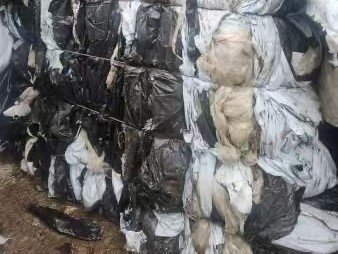
It is also a contamination profile assembled from the annex’s own list. Cable skin carries copper strand and paper wrap. Woven bag arrives with print and lamination. Mulch film comes with soil attached. Municipal mixed rigid drags PET, PS and PVC through the door, and none of those were the target polymer.
A realistic foreign-material load at the press hopper runs 4% to 12%, depending on the stream and how candid the supplier is being. Getting from there to 1.9% is not a magnet and an air separator. It is a washing line, a density separation stage and a drying step — the exact equipment the compression route was built to avoid.
So for the cheap stream, the answer is blunt. The material will not qualify as product. It will keep moving as waste.
Does that kill the business? No. It relocates the paperwork.
The pallet is not the regulated object. A molded pallet leaves the press as a product and always has. End-of-waste governs the recyclate, not the goods made from it.
Nothing about that changes on the day the regulation applies. What changes is the chain behind the press. Your flake supplier either holds a conforming quality system or does not. If they do, you get a per-batch declaration and a product invoice, and your own purchasing file gets simpler. If they do not, you are buying waste, with the notification duties and the movement controls that come with the word.
There is a second clause with sharper teeth, and it points at Asia. Under Article 5, operators in third countries who want to place recycled plastic on the EU market as non-waste have to run the same quality system, audited by a verifier accredited in the EU and competent to work in that country. China filed a comment on the draft on 18 September. The Commission answered on 13 October. That exchange is the friction point for every agglomerate exporter shipping into Rotterdam.
There is also a measurement problem nobody has priced. The declaration attaches to a batch, and the batch definition was lifted straight out of the food-contact recyclate regulation. For a plant pressing 23 kg pallets, a day of production is one batch by any practical reading. Sampling and analysis at that scale costs real money, and the laboratory doing the work has to satisfy the same accredited-audit logic as the quality system. Small plants will feel this more than large ones, which is precisely the complaint the scrutiny board raised about administrative weight on smaller firms.
The cost of the old mess, and the reason prices will not fall
FEAD, the European waste management association, puts the annual cost of having no harmonised criteria at €120 million across EU plastics recyclers. Remove that and the single market for secondary raw materials gets meaningfully cheaper to administer.
Do not expect it to make your feedstock cheaper. Recyclate prices this month are being set by cost, not by demand. European recyclers pushed rHDPE and rPP pellet prices up in the first week of November on energy, transport and diesel, while describing almost no prospect of a Q4 buying recovery. The discount to virgin resin is what caps uptake, and a legal-status change does nothing about that gap.
The demand-side instrument is still missing. The Circular Economy Act slipped again, and the regulatory scrutiny board’s complaint was specific: too little on demand for secondary material, too much administrative weight on smaller firms. Packaging Insights reported Plastics Recyclers Europe calling for the act to put demand at its core, with harmonised EPR, circularity criteria in public procurement and a level import playing field. End-of-waste settles whether recyclate can circulate. It does not settle whether anyone wants to buy it.
What a pallet plant should do before mid-2027
The regulation enters into force 20 days after publication in the Official Journal and applies six months later, which puts practical effect around mid-2027. Chemical recycling — pyrolysis, depolymerisation — is outside the scope entirely, with a review due by 1 January 2029.
Three things are worth doing now, and none of them require capital.
Measure foreign material on your own flake. Not on a supplier’s certificate, and not on the grade you wish you were buying. Sample three deliveries, dry them, and get a number. If you are at 6%, you now know you are a waste processor for the foreseeable future, and you can plan permitting and logistics around that fact instead of discovering it at a border.
Ask every supplier one question in writing: do you hold a quality management system conforming to the end-of-waste annex, and who audits it? The answer sorts your vendor list into two tiers faster than any price negotiation. Suppliers who can say yes will want a premium. Suppliers who cannot will want to keep the relationship, which is leverage.
Decide whether surplus regrind is a product line or a disposal cost. A plant running 250 to 300 pallets a shift generates real quantities of trim, start-up scrap and rejects. Clean that fraction to spec and it can leave the gate as raw material with a declaration attached. Leave it mixed and it leaves as waste with a fee attached.
The part that connects to 2030
One more thing deserves saying, because the two files get discussed separately and should not be.
End-of-waste governs what you buy. The packaging regulation governs what you sell. A pallet mold cut in 2027 will still be pressing pallets in 2030, when recyclability grading starts deciding market access. A tool runs 250,000 to 300,000 cycles, which at two shifts is about two and a half years of production. Colour, filler load and steel inserts get fixed in the tooling drawing, not in a later memo.
A 1.9% threshold on feedstock and an A-to-E grade on the finished pallet are the same conversation held at two ends of the same line. The plants that treat them as one specification will have a dull couple of years and a very good 2030.
For anyone weighing a line against a specific waste stream, the arithmetic starts with the material, not the press. Our plastic pallet machine page lays out the line architecture for mixed and contaminated feedstock, and the dual-station press covers the higher-output configuration. Trial results on a 1,300 × 1,100 mm pallet at roughly 23 kg, 60 seconds of holding time, 2,000 kg dynamic and 6,000 kg static load are published on the news page. If you would rather test your own bales than read our numbers, send a sample and we will run it.
The regulation did not make dirty feedstock illegal. It made the difference between dirty and clean visible on paper, priced and auditable. That is a harder market to compete in, and a better one to win.